


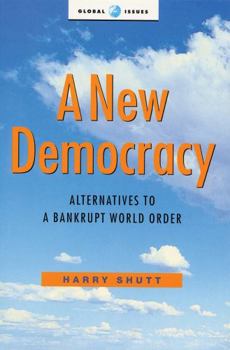
A New Democracy: Alternatives to a Bankrupt World Order (Global Issues)

Harry Shutt argues our world is coming under threat from forces that the ruling elite is increasingly unable to control. Our present economic system is inherently unstable and heading not just for recession, but very serious breakdown. And US domination of international politics cannot last in an age where democracy and respect for human rights are demanded and where marginalisation of most of the world's people is no longer acceptable. This book gives us a trenchant mix of powerful critique and concrete hope. The author exposes the fantasies at the heart of today's market capitalism and counterfeit democracy. Here is a message of hope, a contribution to a new political agenda, and the intellectual ideas to support it.
Format:Paperback
Language:English
ISBN:185649974X
ISBN13:9781856499743
Release Date:November 2001
Publisher:Zed Books
Length:192 Pages
Weight:0.40 lbs.
Dimensions:8.0" x 0.6" x 5.6"
Related Subjects
Business Business & Investing Economics Political Science Politics & Social SciencesCustomer Reviews
1 rating
Politics as Cover for Economics
Published by Thriftbooks.com User , 17 years ago
Kudos to economist Harry Shutt for telling it like it is. "It" is not pretty. Recognizing that the global economic system, "firmly in thrall to corporate America" is corrupt and that the media misinforms the public to keep the crook's advertising dollars pouring in, Shutt says "the world's leadership...appears to resemble that of the doomed Soviet Union in its final phase". In this quick read, Shutt writes that an economic meltdown is inevitable. In an indictment of pathological capitalism (my term), Shutt says that big American corporations "influence the US government into imperial wars abroad", and develops a common theme that "imperialism is incompatible with democracy". Indeed it is, and thus the kudos for saying so. Shutt brings to light some inconvenient truths that make perfect sense, as one will surmise after reading my review of the book, U.S. Television News and Cold War Propaganda, 1947-1960 (Cambridge Studies in the History of Mass Communication). Calling the threat of totalitarian communism "questionable", Shutt writes that "the Cold War was actually a convenient cover for each [US & Soviet Union] to pursue a global strategy of de facto imperialism", AND, I would add, to justify spending $5 trillion on the US military. What Shutt does not spell out here, and you will have to read my review of Rosa Luxemburg's "The Accumulation of Capital" is that war is the mechanism that makes capitalism work, Unfortunately. Shutt defines "de facto imperialism" as "indirect domination through client governments". In other words, puppet governments. In so many words, Shutt says that America does not remove dictators because they are dictators, but rather because they "were deemed insufficiently amenable to US commercial and political interests". But with the fall of the Soviet Union in 1991, the US no longer had a cover for this type of capitalistic subversion. So, prophetically, Shutt writes (this was in early 2001), "There are, it is true, signs that Washington is searching for an alternative bogeyman with which to frighten the world community into at least tacit acceptance of continuing unilateral, extra-legal US intervention in the affairs of sovereign states. The most obvious candidate for this role to date has been the phenomenon identified in the western media as Islamic fundamentalism". And so it was. Eight month's later was 9/11 and the American Corporate State was off and running again. Profits galore. Shutt points out that the economic deterioration of corporate America's global expansion began in the early 1970's after the implosion of Keynesian economics and growth rates have been cut in half. Shutt offers the symptoms of this deterioration, and adds that the most influencial cause is that the structure of the economy has shifted from labor-intensive to 'knowledge-intensive'. Eventually, Shutt gets around to identifying the two crises creating the problem: -Imperialist political control, and the -Capitalist Economic Sy
Copyright © 2025 Thriftbooks.com
Terms of Use | Privacy Policy | Do Not Sell/Share My Personal Information | Cookie Policy | Cookie Preferences | Accessibility Statement
ThriftBooks ® and the ThriftBooks ® logo are registered trademarks of Thrift Books Global, LLC
ThriftBooks ® and the ThriftBooks ® logo are registered trademarks of Thrift Books Global, LLC
