


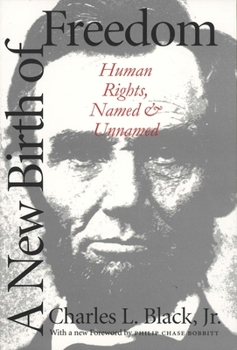
A New Birth of Freedom: Human Rights, Named and Unnamed

Select Format
Select Condition 
Book Overview
"Many . . . unwritten rights are somehow inherent in the American scheme of democracy. So where do these freedoms come from? . . . One of the nation s most venerated thinkers about such matters offers a provocative and refreshing way to answer that question."--Neil A. Lewis, New York Times Book Review "An appealing interpretation of the founding papers."--Michael G. Radigan, New York Law Journal "A remarkably interesting book. It offers a way of looking at the Constitution that I had not thought about before."--Sanford Levinson, School of Law, University of Texas at Austin One of the most respected scholars of constitutional law here argues for a national commitment to human rights based on his interpretation of three critical documents: the Declaration of Independence, the Ninth Amendment to the Constitution, and the "citizenship" and "privileges and immunities" clauses of the Fourteenth Amendment. The book presents a powerful case for reviewing and renewing the basis of our most important human rights.
Format:Paperback
Language:English
ISBN:0300077343
ISBN13:9780300077346
Release Date:March 1999
Publisher:Yale University Press
Length:200 Pages
Weight:0.55 lbs.
Dimensions:0.6" x 5.5" x 8.3"
Customer Reviews
1 rating
Describes the "legal" process of moral dehumanization.
Published by Thriftbooks.com User , 27 years ago
Professor Black has written a thin book that carries an invaluable moral message for America. This message especially may help any one who would limit ethical concerns to such traditionally biased concepts as "family values" or narrowly conceived meanings of "Christian" love. See for example, Dee Brown's (1970, 1991) account of American history in, "Burry My Heart At Wounded Knee." Revelations in that book shocked and angered a number of students who read it recently in a class titled, "Race, Gender, and Corrections." A typical comment was, "Why did I have to get into my senior year of college of learn this? I was always told that the Indians were the bad guys."From a legal perspective, an excellent companion volume for Professor Black's book is A. L. Higginbotham, Jr's. (1996), "Shades of Freedom: Racial politics and presumptions of the American Legal Process." Both books focus on an ominous "legal & quo! ! t; process in American law that can best be described as dehumanization, or more accurately, "double dehumanization." See especially chap. 4 in A. J. Vetlesen's, 1994, "Perception, Empathy, and Judgment: An Inquiry into the Preconditions of Moral Performance," (e.g., p. 180)). Also see Susan Opotow's analysis of "moral exclusion" and the "scope of justice" and Michelle Fine & L. Mun Wong's discussion of "Perceived (In)Justice," in "Conflict, Cooperation, & Justice," (1995), edited by B. Bunker, J. Rubin, and Associates.The only weakness I see in "A New Birth of Freedom" is that Professor Black too narrowly frames his analysis by focusing on the "Slaughterhouse Cases" of 1871. Many other cases are quite relevant as Higginbotham (1996) and a host of scholars show. For example, prior to our uncompleted unCivil War there was the case of Dred Scott v Sanford (1857). More recently, by 6-3 the ! ! U.S. Supreme Court (in City of Boerne v Flores, Bishop of S! an Antonio, and United States, 1997) struck down the legal and human rights concept of "unalienable" (religious) rights that Congress had reaffirmed in the Religious Freedom Restoration Act of 1993. Orlando Patterson (1991, pp. 404-405) in "Freedom in the Making of Western Culture" accurately traces this dehumanizing flaw in America ( & Nazi Germany) back to ancient Greece and idealized philosophers such as Plato.The most fertile ground for understanding the "legal" process of dehumanization that concerns Professor Black probably is in the area of prisoners' rights and the domains known as "criminal" and "juvenile" justice. See the book edited by Elihu Rosenblatt (1996), "Criminal Injustice: Confronting the Prison Crisis"; Human Rights Watch's (1996), "All Too Familiar: Sexual Abuse of Women in U.S. State Prisons"; and Jerome Miller's (1991) classic on juvenile injustice, "Last One Over the Wall. & ! ! quot; On a much needed positive and promising note of valid "moral justice," see: John R. Fuller's (1998), "Criminal Justice: A Peacemaking Perspective"; Daniel Goleman's (1995), "Emotional In
Copyright © 2026 Thriftbooks.com Terms of Use
| Privacy Policy | Do Not
Sell/Share My Personal Information | Cookie Policy | Cookie Preferences | Accessibility Statement
ThriftBooks® and the ThriftBooks® logo are registered trademarks of Thrift Books Global, LLC
ThriftBooks® and the ThriftBooks® logo are registered trademarks of Thrift Books Global, LLC
