


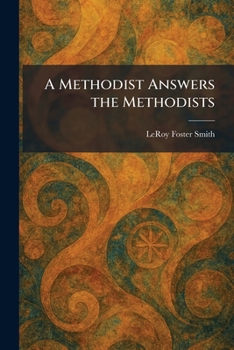
A Methodist Answers the Methodists

"A Methodist Answers the Methodists" is a compelling historical treatise written during a period of significant social and religious introspection in early 20th-century America. Authored by LeRoy F. Smith, this work serves as a critical internal dialogue within the Methodist community, addressing the intersection of religious faith, institutional policy, and national identity.
The text explores the responsibilities of the church in relation to contemporary political and social movements, reflecting the tensions between traditional theological stances and the evolving societal landscape of the 1920s. Smith's perspective provides a unique window into the debates surrounding Americanism and the role of the clergy in public life. By challenging established positions and advocating for a specific interpretation of Methodist duty, the book offers valuable insights into the cultural and religious climate of the era.
This work is an essential resource for those interested in the history of the Methodist Church, the development of religious social thought in the United States, and the broader dialogue between faith and patriotism. Through its rigorous defense of specific ideological values, "A Methodist Answers the Methodists" remains a significant primary source for understanding the complexities of American religious identity during the interwar period.
This work has been selected by scholars as being culturally important, and is part of the knowledge base of civilization as we know it. This work was reproduced from the original artifact, and remains as true to the original work as possible. Therefore, you may see the original copyright references, library stamps (as most of these works have been housed in our most important libraries around the world), and other notations in the work.
This work is in the public domain in the United States of America, and possibly other nations. Within the United States, you may freely copy and distribute this work, as no entity (individual or corporate) has a copyright on the body of the work.
As a reproduction of a historical artifact, this work may contain missing or blurred pages, poor pictures, errant marks, etc. Scholars believe, and we concur, that this work is important enough to be preserved, reproduced, and made generally available to the public. We appreciate your support of the preservation process, and thank you for being an important part of keeping this knowledge alive and relevant.
Customer Reviews
ThriftBooks ® and the ThriftBooks ® logo are registered trademarks of Thrift Books Global, LLC
