


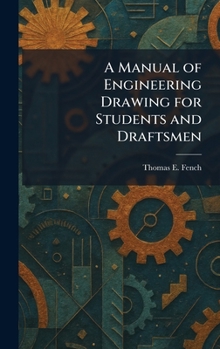
A Manual of Engineering Drawing for Students and Draftsmen

"A Manual of Engineering Drawing for Students and Draftsmen" serves as a comprehensive and foundational guide to the essential art of technical communication. Designed for both the classroom and the professional drafting room, this work explores the principles and techniques required to translate complex mechanical and architectural concepts into precise visual representations.
The manual covers a wide range of topics crucial to the engineering profession, including the correct use of drawing instruments, applied geometry, lettering, and the standards of orthographic projection. It provides detailed instruction on the creation of working drawings, technical sketching, and the nuances of dimensioning and notation. By emphasizing the "language of graphics," the book ensures that draftsmen can convey intricate structural details with clarity and accuracy.
Authored by Thomas E. French, this text has long been recognized for its systematic approach and practical utility. Whether addressing the needs of a student first learning the craft or a seasoned professional seeking a reliable reference, "A Manual of Engineering Drawing for Students and Draftsmen" remains a vital resource in the history of industrial design and engineering education. Its clear explanations and numerous illustrations provide an enduring look at the rigorous standards that defined 20th-century technical drafting.
This work has been selected by scholars as being culturally important, and is part of the knowledge base of civilization as we know it. This work was reproduced from the original artifact, and remains as true to the original work as possible. Therefore, you may see the original copyright references, library stamps (as most of these works have been housed in our most important libraries around the world), and other notations in the work.
This work is in the public domain in the United States of America, and possibly other nations. Within the United States, you may freely copy and distribute this work, as no entity (individual or corporate) has a copyright on the body of the work.
As a reproduction of a historical artifact, this work may contain missing or blurred pages, poor pictures, errant marks, etc. Scholars believe, and we concur, that this work is important enough to be preserved, reproduced, and made generally available to the public. We appreciate your support of the preservation process, and thank you for being an important part of keeping this knowledge alive and relevant.
Customer Reviews
ThriftBooks ® and the ThriftBooks ® logo are registered trademarks of Thrift Books Global, LLC
