


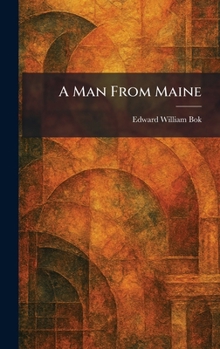
A Man From Maine

"A Man From Maine" is a compelling biographical portrait of Cyrus H. K. Curtis, one of the most influential figures in the history of American publishing. Written by Edward William Bok, a prominent editor and Curtis's son-in-law, the work explores the life and career of the man who transformed the landscape of national periodicals through his leadership of the Curtis Publishing Company.
The narrative follows Curtis's journey from his humble beginnings in Portland, Maine, through his early struggles in the printing trade, to his eventual success as the powerhouse behind iconic publications like "The Saturday Evening Post" and "The Ladies' Home Journal". Bok offers readers an intimate look at Curtis's business philosophy, his unwavering integrity, and his innovative approach to advertising and circulation.
More than just a business biography, "A Man From Maine" serves as an inspirational study of American enterprise and the character required to build a media empire from the ground up. It captures the spirit of the late nineteenth and early twentieth centuries, providing valuable insights into the evolution of the American press and the industrious nature of a man who helped shape the nation's reading habits.
This work has been selected by scholars as being culturally important, and is part of the knowledge base of civilization as we know it. This work was reproduced from the original artifact, and remains as true to the original work as possible. Therefore, you may see the original copyright references, library stamps (as most of these works have been housed in our most important libraries around the world), and other notations in the work.
This work is in the public domain in the United States of America, and possibly other nations. Within the United States, you may freely copy and distribute this work, as no entity (individual or corporate) has a copyright on the body of the work.
As a reproduction of a historical artifact, this work may contain missing or blurred pages, poor pictures, errant marks, etc. Scholars believe, and we concur, that this work is important enough to be preserved, reproduced, and made generally available to the public. We appreciate your support of the preservation process, and thank you for being an important part of keeping this knowledge alive and relevant.
Customer Reviews
ThriftBooks ® and the ThriftBooks ® logo are registered trademarks of Thrift Books Global, LLC
