


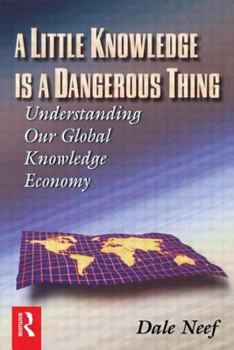
A Little Knowledge Is a Dangerous Thing


Select Format
Select Condition 
Book Overview
Brains, not brawn. The success of countries, companies and people in the next century will depend on what they know and how clever they are at using this knowledge. Dale Neef has given us the best outline yet of the forces behind this extraordinary change in the world economy, the threats and opportunities we all face, and the prizes that await the winners.
Format:Paperback
Language:English
ISBN:0750670614
ISBN13:9780750670616
Release Date:November 1998
Publisher:Routledge
Length:242 Pages
Weight:0.74 lbs.
Dimensions:0.5" x 6.1" x 9.2"
Customer Reviews
1 rating
the high road and the low road
Published by Thriftbooks.com User , 26 years ago
Provides a useful analysis of the place and significance of knowledge management in the development of business and society, though it is limited in the range of societal implications that it considers.The book is well organised, with sound definitions (in a muddy field), a formidable array of facts and good analysis. The explanation of the 'knowledge foundation' (Ch.7) is particularly valuable. Chapters 1 through 6 develop the argument that globalisation and the knowledge economy together amount to a major continuing revolution in the way the world works, and that this revolution is a continuing process, not an event. Chapters 1 through 5 work systematically through the major changes associated with the knowledge economy and globalisation, while Chapter 6 draws important conclusions for the organisation based round six major changes including the level of workforce education, changes in employment, the development of IT in general and groupware in particular, and culture shifts.At this point, Neef introduces the critically important concept of 'high road' and 'low road' organisations and a third group of independent knowledge workers. Essentially, the world is moving towards dominance by a limited number of knowledge based, global organisations, with much of the physical production carried out by relatively small, undercapitalised, low wage 'low road' companies engaged in a 'race to the bottom' and an intermediate group of independent knowledge workers. These corporate polarities are strongly reflected in society, with the trend toward increasing inequalities of income and wealth. Statistics of national wealth are becoming less and less meaningful as the world and nations (even the USA) divide into 'high road' wealthy 'hotspots' (Silicon Valley, the Bangalore region of India etc) and 'low road' areas of economic stagnation or decline.Chapter 7 contains a very useful overview of the place of knowledge management in the world of business. By way of introduction, he points to the confusion caused by the division of KM exponents into 'high-touch' and 'high-tech' groups, where the first are interested primarily in working relationships and culture and the second see KM as primarily a function of new communications technologies, with a third group who see KM 'simply as a way of capturing and distributing leading practices or lessons learned. He seeks to integrate these perspectives around seven broad practice areas.The rest of the book goes broad again, to look at impacts on the social fabric on global competition and implications for (US) national policy. It highlights the implications of 'high road' strategies relative to lack of an explicit strategy or 'low road' strategies and concludes that national government intervention is necessary to ensure that appropriate strategies are followed at a national level.
Copyright © 2026 Thriftbooks.com
Terms of Use | Privacy Policy | Do Not Sell/Share My Personal Information | Cookie Policy | Cookie Preferences | Accessibility Statement
ThriftBooks ® and the ThriftBooks ® logo are registered trademarks of Thrift Books Global, LLC
ThriftBooks ® and the ThriftBooks ® logo are registered trademarks of Thrift Books Global, LLC
