


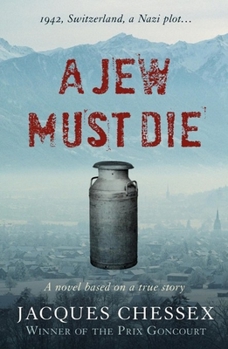
A Jew Must Die


April 1942 - Europe is in flames, but the people of Payerne, Swtizerland, are more concerned with unemployment and local bankruptcy than the fate of nations across the border. Until, that is, a handful of local Nazis lure Arthur Bloch - a Jewish cattle merchant - into a stable and kill him with an iron bar. Based on a true story of political murder in 1940s Switzerland, Chessex' novel is a riveting read.
Format:Paperback
Language:English
ISBN:1904738516
ISBN13:9781904738510
Release Date:April 2010
Publisher:Bitter Lemon Press
Length:122 Pages
Weight:0.30 lbs.
Dimensions:0.4" x 5.0" x 7.6"
Related Subjects
Contemporary Fiction Foreign Language Fiction Genre Fiction Historical Literature & FictionCustomer Reviews
2 ratings
superb WWII drama
Published by Thriftbooks.com User , 16 years ago
Like Asia and North Africa, Europe is on fire as Hitler's bloody war spreads in all direction across the continent. Only Switzerland nestled in the Alps seems immune, but the economy is severely impacted throughout the nation as unemployment and bankruptcies are rising rapidly. Also even in this nation, dark Nazi nightmares exist as some locals work their insidious master plan. In the Swiss market town Payerne, local Nazi leader Fernand Ischi blames the 500 unemployed out of 5000 citizens on the Jews. He encourages teaching them a lesson for being God's abominations by taking their property. On April 16, 1942, Swiss Nazis salute the Fuhrer and his final solution when they persuade sixty years old Jewish cattle merchant Arthur Bloch to enter an empty stable. Once inside they hammer him to death with a crowbar and cut up his body placing the parts into milk containers to float away on the nearby lake on Hitler's birthday. None even show the slightest remorse as Jews deserve this treatment as Ischi believes the first sacrifice takes him on his way to becoming the regional gauleiter leader of the Swiss Nazi Party. That is until the containers fail to float away; Kaddash is prayed for Arthur as it will be for six million others for eternity. Based on a true horror story just like Jacques Chessex's previous tale The Vampire of Ropaz, A Jew Must Die is a gripping translation of a superb French drama that will have readers shocked that such a hate crime occurred. The cast drives the novellas as the audience sees what motivates the monster and his goons to violence, the regional Jewish community to fear, and the local townsfolk to horror. Without preaching, Monsieur Chessex leaves readers to wonder why God tolerates acts of intolerance in his name. Harriet Klausner
Blood and Soil
Published by Thriftbooks.com User , 16 years ago
This short novel, well actually its a novella; no, in fact its a New Yorker-length story, is a semi-fictionalized tale of Switzerland in microcosm in the early War years. It focuses on one small, bourgeois town and its inhabitants, specifically, a group of lumpen proletariats who lack both employment and brains. Infatuated with the slogans of racial superiority bubbling forth from the nearby Third Reich and tantalized with the prospects both of revenge on the seemingly smug burgers of the town for failing to recognize the obviously luminous qualities possessed by the incipient gang and expectations for eventual recognition by the revered Nazis (perhaps a position as "Gaulieter" for one of the adoring acolytes?), the decision is made to kill a local, prominent Jew. That will set an example. It will be a declaration of war on "the other". It will garner accolades. It will wake the town and province to the New Order. The town's leading anti-Semites and Nazi fellow travelers are supportive and the toxic mixture leads, as the reader knows it will, to the inevitable conclusion. It reveals nothing to state that the group is caught and punished, for the story itself is not the major feature of interest, rather it is the writing, or so the reviewers emphasize. First, the style. The author follows a pattern of setting a bucolic and idealized general milieu; of unspoiled Alpine nature, of the picture-book town, of its sturdy inhabitants. He then focuses a bit more closely: the town itself, as beneath its cuckoo-clock exterior rests a foundation of bourgeois values. With a bit of deeper digging, Chessex reveals a bedrock of reactionary and generally unsavory prejudices and self-satisfaction. This stylistic approach repeats through the story. It is effective and achieves its desired goal of pointing out hidden contrasts and creating startling juxtapositions. Second, the writing itself. Chessex uses a generally spare style; modern but not modernist. In the story proper, he says what needs to be said and not too much more. In the concluding chapter, one in which he ties himself directly to the affair, he indulges in a bit more moralizing. Third, the story. This recounts an unfortunate but mundane event, one which doubtlessly was enacted hundreds if not thousands of times during the pre-war, wartime and early post-war years in one form or another. Its happened in Europe, Russia and indeed everywhere else as it is reflective of the sordid and primitive, tribalistic side of human nature: "blood and soil", to borrow a phrase. Yet, it is worth telling once again, especially when told by a writer of Chessex's capabilities. Fourth, the price. This seems like (and it is) a banal point, but a story an average reader can carefully complete in about 30 minutes should have, in my estimation, been included in a collection, rather than sold as an individual (and relatively costly) "monograph". In conclusion, this is an interesting and well-crafte
Copyright © 2026 Thriftbooks.com Terms of Use
| Privacy Policy | Do Not
Sell/Share My Personal Information | Cookie Policy | Cookie Preferences | Accessibility Statement
ThriftBooks® and the ThriftBooks® logo are registered trademarks of Thrift Books Global, LLC
ThriftBooks® and the ThriftBooks® logo are registered trademarks of Thrift Books Global, LLC
