


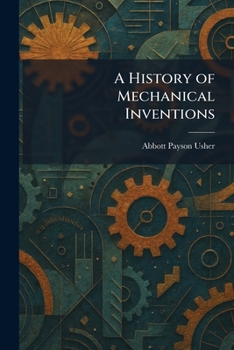
A History of Mechanical Inventions

Select Format
Select Condition 
Book Overview
"A History of Mechanical Inventions" is a seminal study exploring the evolution of mechanical technology and the processes of innovation from early antiquity through the modern industrial age. Written by Abbott Payson Usher, this work provides a rigorous and systematic analysis of how individual inventions arise and contribute to broader technological progress.
The book delves into the technical and social conditions that foster mechanical development, examining the history of key mechanisms such as water wheels, clocks, printing presses, and the steam engine. Usher goes beyond a simple chronological list of discoveries, offering a profound inquiry into the logic of invention and the cumulative nature of human technical skill. He explores the transition from primitive tools to complex machinery, illustrating how each step in mechanical evolution reflects a sophisticated interaction between scientific theory and practical application.
Essential for students of the history of science, engineering, and economic development, "A History of Mechanical Inventions" remains a foundational text for understanding the mechanical foundations of Western civilization. It highlights the ingenuity of the human mind and the transformative power of mechanical mastery over the physical world.
This work has been selected by scholars as being culturally important, and is part of the knowledge base of civilization as we know it. This work was reproduced from the original artifact, and remains as true to the original work as possible. Therefore, you may see the original copyright references, library stamps (as most of these works have been housed in our most important libraries around the world), and other notations in the work.
This work is in the public domain in the United States of America, and possibly other nations. Within the United States, you may freely copy and distribute this work, as no entity (individual or corporate) has a copyright on the body of the work.
As a reproduction of a historical artifact, this work may contain missing or blurred pages, poor pictures, errant marks, etc. Scholars believe, and we concur, that this work is important enough to be preserved, reproduced, and made generally available to the public. We appreciate your support of the preservation process, and thank you for being an important part of keeping this knowledge alive and relevant.
Related Subjects
Engineering History Science Science & Math Science & Scientists Science & Technology TechnologyCustomer Reviews
ThriftBooks ® and the ThriftBooks ® logo are registered trademarks of Thrift Books Global, LLC
