


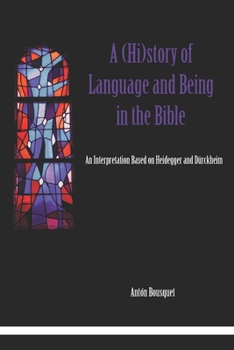
A (Hi)story of Language and Being in the Bible: An Interpretation Based on Heidegger and Dürckheim
No Customer Reviews

Man's language certainly is one of the most important elements distinguishing him from the other creatures roaming the earth. According to Martin Heidegger, it is the "House of Being," man's home and what shapes his own nature. This metaphor is the starting point of the present work, which recounts the (hi)story of the relationship between man's language and his being, using the biblical narrative as a roadmap giving us a vision of the origin of language, of its evolution, and of its end. The biblical narrative here serves as the source for the creation of a "meta-narrative," that is, a new narrative that depicts the metaphysical world opened up by language: the (hi)story of man's relationship with the house of being.
Based on the description offered by the Bible, this meta-narrative tells how the House of Being comes to be built. It describes how this house becomes a village composed of scattered houses following the confusion of tongues at Babel; how the introduction of literacy radically transforms the inhabitants' relation to their own temporality, and how the learning of a foreign language, which comes as a consequence of the Babylonian captivity, offers man the opportunity to appropriate a foreign house and leads him to a homecoming that unveils the nature of his home. Following Pentecost, the village formed by all the houses then becomes a city, as men begin to translate the scriptures into every language, that is, as exchanges occur between all the houses. Finally, the end of language and its relation to man's destiny is examined, in relation to the last days. Rooted in the philosophy of Heidegger and the Zen-influenced spirituality of Karlfried Graf von D rckheim, this work proposes a new vision of the nature of language and its role in man's destiny, one that uses the Bible as a guide but is not bound by its horizon. About the author:Ant n Bousquet is an independent researcher specializing in the philosophy of language, the philosophy of religion, and comparative cultural studies. He holds a Master's degree in Linguistics from the University of Grenoble III in France and a Ph.D. in Comparative Literature and Intercultural Studies from Fu Jen Catholic University in Taiwan. A former teacher of French as a foreign language, he has worked in different parts of Europe, the Middle East, and Asia.
Format:Paperback
Language:English
ISBN:171988501X
ISBN13:9781719885010
Release Date:September 2018
Publisher:Independently Published
Length:598 Pages
Weight:1.74 lbs.
Dimensions:1.3" x 6.0" x 9.0"
Customer Reviews
0 rating
Copyright © 2026 Thriftbooks.com
Terms of Use | Privacy Policy | Do Not Sell/Share My Personal Information | Cookie Notice | Cookie Preferences | Accessibility Statement
ThriftBooks ® and the ThriftBooks ® logo are registered trademarks of Thrift Books Global, LLC
ThriftBooks ® and the ThriftBooks ® logo are registered trademarks of Thrift Books Global, LLC
