


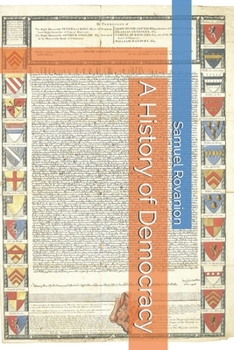
A History of Democracy
No Customer Reviews

This sweeping narrative explores the evolution of democracy from its earliest, often overlooked origins to the modern era. While Athens and the Roman Republic are celebrated as its cradles, the story begins much earlier with the egalitarian practices of hunter-gatherer bands and consultative councils in ancient Mesopotamia and India. By tracing the fundamental human impulse for self-governance, the book reveals how the concept of "rule by the people" has been perpetually invented and reinvented across diverse cultures, far predating the formal institutions we recognize today. The journey continues through the Middle Ages and the Renaissance, highlighting how democratic ideals survived within Italian communes and through the pivotal signing of the Magna Carta. The narrative explores the intellectual ferment of the Enlightenment, where thinkers like Locke, Montesquieu, and Rousseau laid the philosophical groundwork for modern liberty. These ideas fueled the seismic American and French Revolutions, which enshrined popular sovereignty as the legitimate basis of government while exposing the deep tensions between idealistic rhetoric and the reality of exclusion regarding race and gender. Moving into the 19th and early 20th centuries, the book chronicles the "first wave" of democratization and the grueling, multi-generational battle for women's suffrage. It examines the existential threats posed by the rise of totalitarianism-Fascism, Nazism, and Communism-and the subsequent resurgence of democratic governance following World War II. From the decolonization of Africa and Asia to the transformative power of the American Civil Rights Movement, the story tracks the expanding circle of citizenship and the persistent demand for human rights and self-rule on a global scale. In the contemporary era, the text analyzes the "third wave" of democratization that culminated in the fall of the Berlin Wall, alongside more recent uprisings like the Arab Spring. However, it does not offer a simple tale of progress. Instead, it provides a sobering look at the challenges of the digital age, where technology acts as a double-edged sword for both mobilization and surveillance. The narrative dives into the rise of modern populism, the erosion of trust in institutions, and the growing phenomenon of "democratic backsliding" that threatens established systems from within. Finalizing the account, the book examines how global issues like economic inequality and climate change act as the ultimate stress tests for democratic health. By looking toward the future, it explores possibilities for democratic renewal through innovation and deliberative practices. This comprehensive history serves as a reminder that democracy is a fragile, unfinished experiment-a chronicle of triumphs and tragedies that requires the active participation of every generation to survive.
Format:Paperback
Language:English
ISBN:B0GYNZ7G7W
ISBN13:9798258985118
Release Date:April 2026
Publisher:Independently Published
Length:190 Pages
Weight:0.58 lbs.
Dimensions:0.4" x 6.0" x 9.0"
Related Subjects
HistoryCustomer Reviews
0 rating
Copyright © 2026 Thriftbooks.com
Terms of Use | Privacy Policy | Do Not Sell/Share My Personal Information | Cookie Policy | Cookie Preferences | Accessibility Statement
ThriftBooks ® and the ThriftBooks ® logo are registered trademarks of Thrift Books Global, LLC
ThriftBooks ® and the ThriftBooks ® logo are registered trademarks of Thrift Books Global, LLC
