


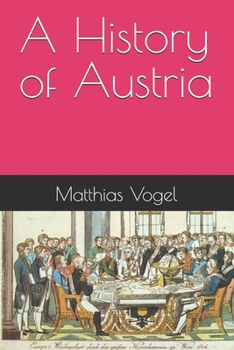
A History of Austria

From a small frontier march of Charlemagne's empire to the heart of a global power, this history tells the epic story of Austria's dramatic journey through the centuries. Situated at the crossroads of Europe, the nation's destiny was forged by the visionary and famously fortunate House of Habsburg, whose shrewd policy of "let others wage war; you, happy Austria, marry " built a sprawling empire. This account traces their ascent, from their victory on the Marchfeld in 1278 to their rule over an empire on which the sun never set. It explores the great challenges that defined Austria's role in Europe: the life-or-death struggle against the Ottoman Empire, culminating in the heroic sieges of Vienna, and the deep religious divisions of the Reformation and the Thirty Years' War.
Out of the crucible of conflict, the Austrian monarchy emerged as a great European power, celebrating its triumphs in the magnificent, exuberant art and architecture of the Baroque era. The narrative delves into the age of reform, led by the pragmatic Empress Maria Theresa and her radical son, Joseph II, who wrestled with the ideas of the Enlightenment to modernize their vast and diverse lands. This era of change was shattered by the Napoleonic Wars, a quarter-century of conflict that led to the end of the thousand-year-old Holy Roman Empire and the birth of a new Austrian Empire. Under the brilliant and conservative statesman Prince Metternich, Vienna became the diplomatic capital of a restored continent, leading the fight against the new forces of revolution.
The 19th century proved to be a period of immense contradiction. The empire was shaken to its core by the rise of liberalism and nationalism, which erupted in the Revolutions of 1848. After devastating military defeats forced Austria out of Germany and Italy, the empire was fundamentally reshaped into the unique Austro-Hungarian Dual Monarchy. Yet, even as its political power waned, its capital, Vienna, experienced an unparalleled cultural golden age. This was the era of the Ringstrasse, the waltz, and the coffeehouse-a glittering world of art, music, and ideas that gave birth to modernism with figures like Freud, Klimt, and Mahler, even as the unresolved tensions of its many nationalities pushed the state toward a final, catastrophic confrontation.
This history chronicles the tragic slide into the First World War, sparked by an assassination in Sarajevo, and the subsequent, total collapse of the Habsburg Empire in 1918. From the ashes, a small, troubled republic was born, a state defined by economic turmoil and the bitter ideological clash between the socialist experiment of "Red Vienna" and a rising tide of authoritarianism. The narrative follows Austria's descent into the civil war and Austrofascism of the 1930s, culminating in the traumatic 1938 Anschluss-the annexation by Nazi Germany. It unflinchingly examines Austria's seven-year role within the Third Reich, a period of widespread complicity that ended in the devastation of war and occupation.
Finally, the book tells the remarkable story of Austria's rebirth after 1945. It details the ten-year Allied occupation that ended with the historic 1955 State Treaty, which restored the nation's sovereignty on the condition of permanent neutrality. This new identity allowed Austria to transform itself into a prosperous and stable democracy, a trusted international mediator during the Cold War, and a comprehensive modern welfare state. The story concludes with the nation's journey through the fall of the Iron Curtain, the momentous decision to join the European Union, and the complex political and social challenges it faces as it navigates its new identity at the heart of 21st-century Europe.
Related Subjects
HistoryCustomer Reviews
ThriftBooks® and the ThriftBooks® logo are registered trademarks of Thrift Books Global, LLC
