


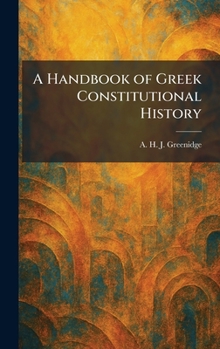
A Handbook of Greek Constitutional History

"A Handbook of Greek Constitutional History" provides a comprehensive and scholarly examination of the political development and governance of the ancient Greek city-states. Written by the esteemed historian A.H.J. Greenidge, this work traces the evolution of constitutional systems from the early monarchies and aristocracies to the sophisticated democratic and oligarchic structures of the classical era.
The book delves into the internal organizations of key states, most notably Athens and Sparta, analyzing the roles of magistrates, councils, and assemblies. Greenidge explores the legal frameworks that underpinned Greek society and the philosophical ideals that shaped their political life. By examining the growth of law and the administration of justice, the author illustrates how these ancient institutions influenced the broader trajectory of Western political thought.
Designed as both a thorough introduction for students and a valuable reference for scholars, this handbook offers meticulous detail on the historical processes that led to the various forms of Greek government. It remains an essential resource for anyone seeking to understand the foundational principles of constitutionalism and the complexities of political life in the ancient world.
This work has been selected by scholars as being culturally important, and is part of the knowledge base of civilization as we know it. This work was reproduced from the original artifact, and remains as true to the original work as possible. Therefore, you may see the original copyright references, library stamps (as most of these works have been housed in our most important libraries around the world), and other notations in the work.
This work is in the public domain in the United States of America, and possibly other nations. Within the United States, you may freely copy and distribute this work, as no entity (individual or corporate) has a copyright on the body of the work.
As a reproduction of a historical artifact, this work may contain missing or blurred pages, poor pictures, errant marks, etc. Scholars believe, and we concur, that this work is important enough to be preserved, reproduced, and made generally available to the public. We appreciate your support of the preservation process, and thank you for being an important part of keeping this knowledge alive and relevant.
Customer Reviews
ThriftBooks ® and the ThriftBooks ® logo are registered trademarks of Thrift Books Global, LLC
