


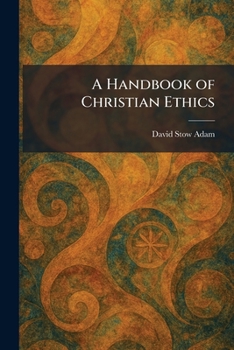
A Handbook of Christian Ethics

Select Format
Select Condition 
Book Overview
"A Handbook of Christian Ethics" serves as a comprehensive and systematic investigation into the moral principles and practical applications of the Christian faith. Written by the esteemed theologian David Stow Adam, this work explores the foundation of Christian conduct, tracing the evolution of ethical thought from its biblical origins to its expression in individual and social life.
The text is divided into sections that meticulously examine the nature of the Christian ideal, the development of the moral conscience, and the specific duties of the believer within the family, the state, and the church. Adam provides a clear articulation of the relationship between faith and works, emphasizing the role of the Holy Spirit in the moral transformation of the individual. As a scholarly yet accessible guide, the book addresses the complexities of moral decision-making, offering a rigorous framework for understanding how Christian values inform daily life and societal structures.
This handbook remains a significant resource for students of theology, philosophy, and religious history, providing a timeless perspective on the ethical dimensions of Christianity. It stands as a testament to the enduring quest to align human action with divine purpose, making it an essential volume for anyone interested in the intersection of religion and morality.
This work has been selected by scholars as being culturally important, and is part of the knowledge base of civilization as we know it. This work was reproduced from the original artifact, and remains as true to the original work as possible. Therefore, you may see the original copyright references, library stamps (as most of these works have been housed in our most important libraries around the world), and other notations in the work.
This work is in the public domain in the United States of America, and possibly other nations. Within the United States, you may freely copy and distribute this work, as no entity (individual or corporate) has a copyright on the body of the work.
As a reproduction of a historical artifact, this work may contain missing or blurred pages, poor pictures, errant marks, etc. Scholars believe, and we concur, that this work is important enough to be preserved, reproduced, and made generally available to the public. We appreciate your support of the preservation process, and thank you for being an important part of keeping this knowledge alive and relevant.
Customer Reviews
ThriftBooks ® and the ThriftBooks ® logo are registered trademarks of Thrift Books Global, LLC
