


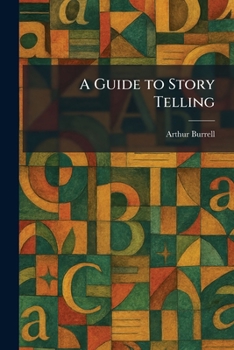
A Guide to Story Telling

Select Format
Select Condition 
Book Overview
"A Guide to Story Telling" by Arthur Burrell is a foundational exploration of the narrative arts, designed to help practitioners master the timeless skill of oral communication. Drawing on the author's extensive experience in education and speech, this work provides a comprehensive overview of how to select, prepare, and deliver stories that captivate audiences of all ages. Burrell delves into the mechanics of effective storytelling, offering practical advice on the use of voice, gesture, and pacing to breathe life into written words.
The book emphasizes the educational and cultural value of the oral tradition, positioning storytelling not just as entertainment but as a vital tool for teaching and emotional connection. Readers will find guidance on adapting folklore, historical accounts, and literary classics for various settings, from the classroom to the social circle. By focusing on the intrinsic power of the spoken word, "A Guide to Story Telling" serves as an essential resource for anyone looking to refine their ability to convey complex themes through simple, engaging narratives. This volume remains a significant contribution to the study of speech and literary pedagogy, preserving techniques that bridge the gap between literature and live performance.
This work has been selected by scholars as being culturally important, and is part of the knowledge base of civilization as we know it. This work was reproduced from the original artifact, and remains as true to the original work as possible. Therefore, you may see the original copyright references, library stamps (as most of these works have been housed in our most important libraries around the world), and other notations in the work.
This work is in the public domain in the United States of America, and possibly other nations. Within the United States, you may freely copy and distribute this work, as no entity (individual or corporate) has a copyright on the body of the work.
As a reproduction of a historical artifact, this work may contain missing or blurred pages, poor pictures, errant marks, etc. Scholars believe, and we concur, that this work is important enough to be preserved, reproduced, and made generally available to the public. We appreciate your support of the preservation process, and thank you for being an important part of keeping this knowledge alive and relevant.
Customer Reviews
ThriftBooks ® and the ThriftBooks ® logo are registered trademarks of Thrift Books Global, LLC
