


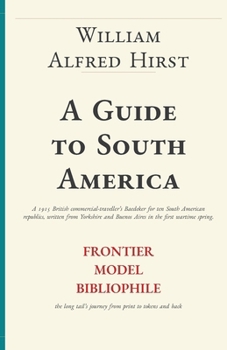
A Guide to South America
No Customer Reviews

When W. A. Hirst finished this manuscript in February 1915, he signed the preface from the Yorkshire Hussars at Harrogate, his publication delayed by "the war and again by my military duties." The book that finally appeared is the most systematic single-volume British guide to South America issued during the First World War: a working handbook to ten republics, organised by country, with railway timetables, port tonnages, hotel rates in shillings, consular addresses, and frank assessments of agricultural and mineral prospects. Argentina, where Hirst had already published a separate volume, receives the longest and most confident treatment; Paraguay and the equatorial north are dispatched with brisk economy. Read today, the book is at once a commercial almanac, a colonial business-class itinerary, and an unguarded record of how London understood the continent at the moment German submarine warfare and rising United States capital were about to reshape every assumption it contains. Frontier Model Bibliophile presents the 1915 Macmillan edition as a facsimile, with new editorial apparatus. A Guide to South America is, on its face, a working handbook. Hirst opens with a suggested six-month itinerary out of Liverpool or Southampton, names the steamship lines that carry the traveller (Pacific Steam Navigation, Royal Mail Steam Packet), and then proceeds country by country through Argentina, Brazil, Chile, Uruguay, Paraguay, Bolivia, Peru, Ecuador, Colombia, and Venezuela. For each republic the reader receives a compressed account of geography, population, government, principal industries, the main lines of railway with first-class return fares quoted in pounds and shillings, the major cities with hotel names and tariffs, and the British consular establishment down to the vice-consul. Ten folding maps are included. What sets the book apart from the smaller "handbook published in the United States" and the Royal Mail Steam Packet Company's promotional pamphlet, which Hirst names as the only existing competitors, is its scale and its commercial seriousness: this is not a tourist's guide but a guide for the British man of business considering the South American trade in a wartime year. The world the book came from is the world of the late-Edwardian City of London, which by 1914 had financed a very substantial share of the foreign capital invested in South America - the British-owned railways of Argentina, the nitrate works of northern Chile, the river-fleet and tramway concessions, the meat-packing plants of the River Plate, and the Peruvian sugar estates. Hirst writes from inside that capital flow. He is matter-of-fact about Pedro de Mendoza setting down seventy-two horses on the pampas in 1536; he is equally matter-of-fact about an Argentine census recording 67 million sheep, 29 million cattle, and 473,644 tons of red quebracho logs exported in 1911. His preface assigns the book a wartime purpose - "the question of food supplies is prominent and the successors of Cochrane have cleared the South American coast from the marauder" - and the comparison to Lord Cochrane, the early-nineteenth-century British naval officer who built the Chilean navy, is not decorative. Hirst's South America is a place whose modern political form was, in his view, partly the work of Britons, and whose commercial future was a British interest worth defending. The fact that the same preface is signed from a yeomanry barracks at Harrogate gives the position its biographical accent: the author is in uniform. For a present-day reader, what the book transmits is the texture of an assumption.
Format:Paperback
Language:English
ISBN:B0HG4NCHRT
ISBN13:9798259506923
Release Date:April 2027
Publisher:Frontier Model Bibliophile
Length:374 Pages
Weight:0.95 lbs.
Dimensions:0.8" x 5.5" x 8.5"
Customer Reviews
0 rating
Copyright © 2026 Thriftbooks.com
Terms of Use | Privacy Policy | Do Not Sell/Share My Personal Information | Cookie Notice | Cookie Preferences | Accessibility Statement
ThriftBooks ® and the ThriftBooks ® logo are registered trademarks of Thrift Books Global, LLC
ThriftBooks ® and the ThriftBooks ® logo are registered trademarks of Thrift Books Global, LLC
