


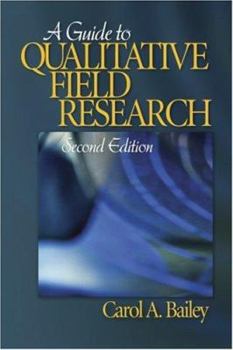
A Guide to Qualitative Field Research

Select Format
Select Condition 
Book Overview
Thoroughly revised, the Second Edition of A Guide to Qualitative Field Research provides novice researchers with comprehensive and accessible instructions for conducting qualitative field research. Using rich examples from classic ethnographies to help bring abstract principles alive, author Carol A. Bailey thoroughly explains the entire research process from selecting a topic to writing the final manuscript, and all of the steps in between
New to the Second Edition:
Offers Ten Techniques for Analyzing Data Step-by-step instructions on how to use various techniques for analyzing data are provided that demystify what is often an overwhelming activity. There are three chapters devoted to ten techniques, including descriptions, typologies, taxonomies, visual representations, themes, story telling, critical events, and analytic induction. Provides Increased Coverage of Ethics Ethical issues in field research are examined, including the American Sociological Association′s Code of Ethics in a new Chapter 2. This coverage illuminates that ethical concerns are always present and ethical dilemmas are not always easily resolved. Includes New Discussions of Paradigms More coverage of paradigms is given as well as their implications for the research enterprise, sampling, reflexivity, member checks, triangulation, and criteria for evaluating field research. This new edition has been significantly reorganized and expanded with a greater focus on the role of theory.
New to the Second Edition:
Offers Ten Techniques for Analyzing Data Step-by-step instructions on how to use various techniques for analyzing data are provided that demystify what is often an overwhelming activity. There are three chapters devoted to ten techniques, including descriptions, typologies, taxonomies, visual representations, themes, story telling, critical events, and analytic induction. Provides Increased Coverage of Ethics Ethical issues in field research are examined, including the American Sociological Association′s Code of Ethics in a new Chapter 2. This coverage illuminates that ethical concerns are always present and ethical dilemmas are not always easily resolved. Includes New Discussions of Paradigms More coverage of paradigms is given as well as their implications for the research enterprise, sampling, reflexivity, member checks, triangulation, and criteria for evaluating field research. This new edition has been significantly reorganized and expanded with a greater focus on the role of theory.
Intended Audience:
Clearly written, this accessible text is ideal for advanced undergraduate and graduate students studying qualitative methods and evaluation research across the social sciences.
Format:Paperback
Language:English
ISBN:1412936500
ISBN13:9781412936507
Release Date:September 2006
Publisher:SAGE Publications, Inc
Length:232 Pages
Weight:0.75 lbs.
Dimensions:9.0" x 0.5" x 6.0"
Customer Reviews
2 ratings
Had to read it For a Class, Better Than Most on the Subject
Published by Thriftbooks.com User , 17 years ago
I thought that this book was helpful. Bailey gives ten ways to analyze data collected during field research. She also has an extended discussion of ethics on the field. She gives many exmaples of situations where it would appear that it would be all right to break confidentiality, and then she says "no." Yet she does acknowledge extraordinary exceptions to the rule. Better than most books I have come across, this one helps a person to think through the possible circumstances that could come up during field research and ultimately, whether or not a person would want to do a certain project. Recommended.
A Guide to Field Research
Published by Thriftbooks.com User , 23 years ago
"The Big Picture: A Guide to Field Research" gives the beginner researcher a manual to follow when conducting an ethnographic project. Carol Bailey uses real life examples throughout her book to illustrate ideas. The book is nicely written and easy to read with a subtitle for each new idea presented. Bailey explains step-by-step research strategies to guide the student ethnographer through the processes of "selecting a project" to "writing the final paper." This book covers fundamentals of field research and is a good guide for the student ethnographer. I would recommend reading this book prior to beginning any ethnographic field research project.
Copyright © 2026 Thriftbooks.com
Terms of Use | Privacy Policy | Do Not Sell/Share My Personal Information | Cookie Policy | Cookie Preferences | Accessibility Statement
ThriftBooks ® and the ThriftBooks ® logo are registered trademarks of Thrift Books Global, LLC
ThriftBooks ® and the ThriftBooks ® logo are registered trademarks of Thrift Books Global, LLC
