


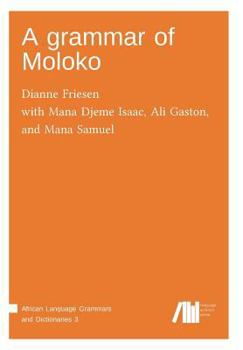
A grammar of Moloko
No Customer Reviews

Select Format
Select Condition 
Book Overview
This grammar provides the first comprehensive grammatical description of Moloko, a Chadic language spoken by about 10,000 speakers in northern Cameroon. The grammar was developed from hours and years that the authors spent at friends' houses hearing and recording stories, hours spent listening to the tapes and transcribing the stories, then translating them and studying the language through them. Time was spent together and with others speaking the language and talking about it, translating resources and talking to Moloko people about them. Grammar and phonology discoveries were made in the office, in the fields while working, and at gatherings. In the process, the four authors have become more and more passionate about the Moloko language and are eager to share their knowledge about it with others. Intriguing phonological aspects of Moloko include the fact that words have a consonantal skeleton and only one underlying vowel (but with ten phonetic variants). The simplicity of the vowel system contrasts with the complexity of the verb word, which can include information (in addition to the verbal idea) about subject, direct object (semantic Theme), indirect object (recipient or beneficiary), direction, location, aspect (Imperfective and Perfective), mood (indicative, irrealis, iterative), and Perfect aspect. Some of the fascinating aspects about the grammar of Moloko include transitivity issues, question formation, presupposition, and the absence of simple adjectives as a grammatical class. Most verbs are not inherently transitive or intransitive, but rather the semantics is tied to the number and type of core grammatical relations in a clause. Morphologically, two types of verb pronominals indicate two kinds of direct object; both are found in ditransitive clauses. Noun incorporation of special 'body-part' nouns in some verbs adds another grammatical argument and changes the lexical characteristics of the verb. Clauses of zero transitivity can occur in main clauses
Format:Paperback
Language:English
ISBN:3961100101
ISBN13:9783961100101
Release Date:July 2017
Publisher:Language Science Press
Length:472 Pages
Weight:1.64 lbs.
Dimensions:0.9" x 6.7" x 9.6"
Related Subjects
Language ArtsCustomer Reviews
0 rating
Copyright © 2026 Thriftbooks.com
Terms of Use | Privacy Policy | Do Not Sell/Share My Personal Information | Cookie Policy | Cookie Preferences | Accessibility Statement
ThriftBooks ® and the ThriftBooks ® logo are registered trademarks of Thrift Books Global, LLC
ThriftBooks ® and the ThriftBooks ® logo are registered trademarks of Thrift Books Global, LLC
