


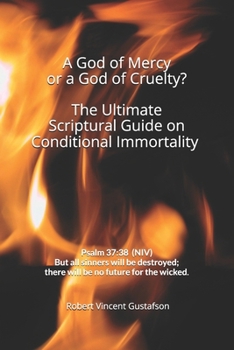
A God of Mercy or a God of Cruelty? The Ultimate Scriptural Guide on Conditional Immortality

This book offers numerous fresh insights that even prominent scholars of conditional immortality have missed. For example, here is one of the crucially important discoveries I made that I present in chapter one. See how the word ransom in the Scriptures refers to saving someone from death-not eternal torment. Here is how the argument unfolds. Mark 10:45 states that Christ gave his life as a ransom for many. And by using the word "ransom" and the word "life" in this verse, the meaning is clear. Christ gave his life to pay for our lives, saving us from the death we rightly deserve. This verse says nothing about regaining the purpose or meaning of someone's life as traditionalists have claimed. The Bible simply teaches that a ransom delivers a person from death, as this verse clearly illustrates.
Exod. 21:30If a ransom is imposed on him, then he shall give for the redemption of his life whatever is imposed.
This is a universally recognized principle about how a ransom works: a ransom only buys back a person's life. That is all. Let us now examine another Scripture which tells us that no amount of money can pay the ransom that God requires to buy back the life of a person-so that they may live forever.
Ps. 49:7-9No one can redeem the life of another or give to God a ransom for them- the ransom for a life is costly, no payment is ever enough- so that they should continue to] live on forever and not see decay.
And the phrase: continue to, is the precise translation. Here is the definition of the Hebrew word owd (continue to) used in this verse.
from uwd; properly, iteration or continuance; used only adverbially (with or without preposition), again, repeatedly, still, more
And so Ps. 49:9 is similar to John 12:25 which says that a person can "keep their life." John 12:25The one who loves his life will lose it, and the one who hates his life in this world will keep it for eternal life. These verses disprove the traditionalist claim of the unsaved continuing or keeping their life, albeit a terrible one in hell for eternity. And then, there is this verse, which every non-traditionalist Bible scholar has overlooked as definitive proof of soul sleep. Rev. 1:17-18
When I saw him, I fell at his feet like a dead man. He laid his right hand on me and said, "Don't be afraid. I am the First and the Last, and the Living One. I was dead, but look-I am alive forever and ever, and I hold the keys of death and Hades. As you can see, Christ declared that he is the First and the Last, the Living One who was dead and then came to life again, clearly revealing that it was his eternal nature that died. This is how he was able to purchase "eternal" salvation for us, which the Old Testament sacrifices were never able to achieve. This means that his spirit had to die. As Edward Fudge correctly observed in the Scriptures, Christ's spirit was in Hades during the three days of his death. (See pp. 44-45, The Fire That Consumes) So it would have been literally impossible for his spirit to ascend to paradise with the thief's spirit on the day he died. Because if that had actually happened, then it would have been the same situation before the world was created. At that time, God the Father, the Holy Spirit and Christ all existed as spiritual beings. There was no body of Christ back then. Therefore, no one can legitimately claim that Christ's body is the First and the Last. Be sure to check out the "Read Sample" feature for the eBook - it offers a more detailed overview of the book chapters, including a few other fresh insights that are just as straightforward and clear as those I have shared here. You need to click back a few pages to find it. The overview will not appear in the paperback or hardcover editions. If you have any comments or questions, feel free to contact me at robertgustafsonauthor@gmail.com.
Customer Reviews
ThriftBooks® and the ThriftBooks® logo are registered trademarks of Thrift Books Global, LLC
