


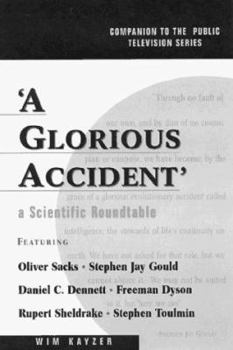
A Glorious Accident: Understanding Our Place in the Cosmic Puzzle


Select Format
Select Condition 
Book Overview
Containing a set of interviews and philosophical questions with six scientists and thinkers-about-science, this volume culminates in a long round table discussion among the six: Oliver Sacks, Daniel... This description may be from another edition of this product.
Format:Hardcover
Language:English
ISBN:0716731444
ISBN13:9780716731443
Release Date:January 1997
Publisher:W H Freeman & Co
Length:306 Pages
Weight:1.42 lbs.
Dimensions:9.5" x 1.3" x 6.3"
Customer Reviews
5 ratings
The Wonder and Tedium of Existence
Published by Thriftbooks.com User , 19 years ago
The title of this book comes from (who else?) Stephen J Gould. This is what a scientific discussion could be and should be. In short, six famous thinkers were asked to participate in first an individual interview and then a round table discussion with the other five. The subject was life in all its mundane and complex makeup with a special emphasis on consciousness, computers, free will and the future. Almost a "What does it mean to be human?" Each contributed something special - Oliver Sacks was almost infectious, a child masquerading as a grownup. From his case studies of neurological quirks he has dericed a thery of consciousness and being. Daniel Dennett, the "materialist" of the group, sees the body (and brain) as a complex machine (my personal view) and ventures that since our mind derives from a purely materialistic basis (the atoms in our brains) computers will one day acquire consciousness in complexity. Gould was his usual biting, sarcastic, iconoclastic self - as sure of his own opinions as we was disdainful of others (loved the crack at Dawkins). He represents that almost perfect blend of working scientists, philosopher with the common man touch. Freeman Dyson, the cosmos futurists reminded one of the 19th century with his serious, old-fashioned manner. Rupert Sheldrake tried his best to insert some New Age wisdom and for the most part, failed. His ideas were original but stillborn. Stephen Toulmin plays the part of the man who gets the last word, the scientific historian who finds errors from the early days of philosophy. He is simultaneously authoritative and, in a way, the undeclared leader of the group. My only criticism was the redundancy of the questions. These six men had wide-ranging backgrounds and ideas so why ask them the same questions? The panel discussion was the very model of civility, intellectual give and take and yet another glimpse into the working of the mind even as they discussed who it did just that! The book has been described as difficult for the layman but any well-read amateur can easily follow the thrusts of the speakers. My grade: A
Where is the DVD?!
Published by Thriftbooks.com User , 20 years ago
One of the most interesting shows ever aired on public television (WNET, New York) was Wim Kayzer's interviews with six leading intellectuals who represented both the mainstream academic (Stephen J. Gould, Freeman Dyson and Stephen Toulmin) and more or less, as it were, "eccentric" outside the box groudbreaking intellectuals (Oliver Sacks and Rupert Sheldrake). Kayzer interviews each of them (and philospher Daniel Dennett) individually and then has the entire group sit in a kind of round-table seminar that he moderates and lets the ideas fly. In mho it is unconscionable that there has never been a DVD release of this unique and amazing historical experiment in intellectual dialogue. And while Kayzer's book pretty much reproduces the dialogues, seeing is believing.
Beats hell out of Plato's Symposium
Published by Thriftbooks.com User , 20 years ago
With the likely exception of Rupert Sheldrake, it would be hard to top Wim Kayser's after-dinner philosophical roundtable invitations. And, on Sheldrake, back in the 1990s, he sounded like someone with fresh and thought-provoking ideas, not a philosophical dualist on the borderlands of pseudoscience. That said, this book is easier to understand if you've seen the video from which the conversation transcripts were made. I saw it air on PBS, which stimulated me to get the book. Later, I then saw the video again. This indeed is not for beginners; you should have some grounding in cognitive science/philosophy, analytic philosophy, the natural sciences or philosophy of science, preferably at least a bit in more than one of those disciplines. BUt, if you do, and want to be mentally challenged at a high level, then definitely read this book. And buy or rent the video, too.
Potpourri of interesting ideas, but solid background needed!
Published by Thriftbooks.com User , 26 years ago
"A glorious accident" is not an easy book... Five leading experts talking about some of the most profound subjects available(consciousness, evolution, the Brain...). It takes quite a lot of background to understand everything that is being said. The fact that these are just transcriptions of interviews and a discussion doesn't make it easier: compared to a normal "book", the ideas presented are not as structured and there's no room for background information to introduce readers in complex matters like Witgensteins philosophy or "orthogenesis" and "epistothisandthat". If Descartes, Newton, Heisenberg, Galileo, Montaigne, Darwin, Dirac, Kant, Turing, Aristoteles or Maxwell are completely unknown to you, this is not YOUR kind of book. :-)In 1991, I saw parts of the original television series. A few years later I read the Dutch printed version for the first time at the age of 20. Now (1999) I've read it again, and there are still quite a few passages where I'm totally lost in space . Now I don't have a degree in philosophy or physics, but still I have a healthy interest in these issues. Not enough to constantly keep in touch with 5 leading experts discussing without holding back..What is nice about this book, is that you can "grow with it". In around 2005, I'll read it for the 3th time and no doubt I'll conquer some more dark areas.The "interview" approach also gives quite a good impression of the personalities of these five extraordinary men. Sacks is still like a little child that has preserved his ability to wonder about all and everything. You just CAN'T bore this guy because he always finds an interesting approach! Gould is my absolute favourite. Because his ideas appeal to me, and because he is so totally "no-nonsense". Sheldrake is the rebellion with his heart in the right place. Dyson is the quiet one with the hidden powers. Dennett is so self-confident that it looks almost as if he can force reality to comply to his theories instead of the other way round. Toulmin is a bit too literate for my taste: he always gave me the feeling that I was a few steps behind. Not good for the ego All in all I would say that the book lacks structure because of the interview approach, but there are still more than enough interesting bits of original ideas and insight to make it worthwile.Jo Helsen Antwerp, Belgium
One of those books that you will not want to lend
Published by Thriftbooks.com User , 28 years ago
A wonderful read for the philosopher scientist, or anyone interested in the question of mind vs. brain and how it all came about. It will lead you to further explorations of the works of the participants. Time well spent.
Copyright © 2026 Thriftbooks.com
Terms of Use | Privacy Policy | Do Not Sell/Share My Personal Information | Cookie Policy | Cookie Preferences | Accessibility Statement
ThriftBooks ® and the ThriftBooks ® logo are registered trademarks of Thrift Books Global, LLC
ThriftBooks ® and the ThriftBooks ® logo are registered trademarks of Thrift Books Global, LLC
