


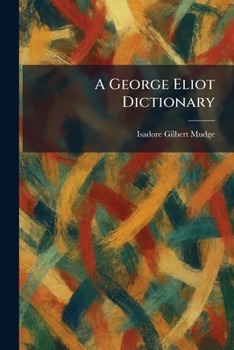
A George Eliot Dictionary

"A George Eliot Dictionary" is a comprehensive reference work designed to aid readers and scholars in navigating the intricate world created by one of the Victorian era's most profound novelists. This scholarly guide provides an exhaustive index of the characters, places, and literary motifs found across George Eliot's entire body of work, including "Middlemarch", "Silas Marner", "The Mill on the Floss", and "Daniel Deronda".
The dictionary serves as a vital companion for understanding the complex social webs and moral landscapes Eliot constructed. Each entry offers detailed context, identifying the roles of minor and major characters alike, while also tracing the geographical settings that ground her narratives in a specific sense of time and place. Beyond a simple list of names, this work explores the recurring themes and philosophical undercurrents that define Eliot's unique contribution to English literature.
Perfect for students, researchers, and devoted fans of Victorian fiction, this volume ensures that no nuance of Eliot's expansive literary universe goes unnoticed. By organizing the vast array of personas and locations found in her novels, the dictionary facilitates a deeper appreciation for the psychological depth and realism that earned Mary Ann Evans her place as a titan of the literary canon.
This work has been selected by scholars as being culturally important, and is part of the knowledge base of civilization as we know it. This work was reproduced from the original artifact, and remains as true to the original work as possible. Therefore, you may see the original copyright references, library stamps (as most of these works have been housed in our most important libraries around the world), and other notations in the work.
This work is in the public domain in the United States of America, and possibly other nations. Within the United States, you may freely copy and distribute this work, as no entity (individual or corporate) has a copyright on the body of the work.
As a reproduction of a historical artifact, this work may contain missing or blurred pages, poor pictures, errant marks, etc. Scholars believe, and we concur, that this work is important enough to be preserved, reproduced, and made generally available to the public. We appreciate your support of the preservation process, and thank you for being an important part of keeping this knowledge alive and relevant.
Customer Reviews
ThriftBooks® and the ThriftBooks® logo are registered trademarks of Thrift Books Global, LLC
