


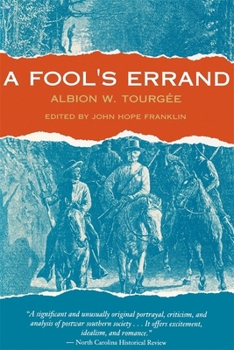
A Fool's Errand

Select Format
Select Condition 
Book Overview
What was a carpetbagger? Albion W. Tourg?e was called one, and he wrote, "To the southern mind it meant a scion of the North, a son of an 'abolitionist, ' a creature of the conqueror, a witness to their defeat, a mark of their degradation: to them he was hateful, because he recalled all of evil or of shame they had ever known ... To the Northern mind, however, the word had no vicarious significance. To their apprehension, the hatred was purely personal, and without regard to race or nativity. They thought (foolish creatures!) that it was meant to apply solely to those, who, without any visible means of support, lingering in the wake of a victorious army, preyed upon the conquered people."
Tourg?e's novel, originally published in 1879 anonymously as A Fool's Errand, By One of the Fools, is not strictly autobiographical, though it draws on Tourg?e's own experiences in the South. In the story Comfort Servosse, a Northerner of French ancestry, moves to a Southern state for his health and in the hope of making his fortune. These were also Tourg?e's motives for moving South. Servosse is caught up in a variety of experiences that make apparent the deep misunderstanding between North and South, and expresses opinions on the South's intolerance, the treatment of the Negro, Reconstruction, and other issues that probably are the opinions of Tourg?e himself. "Reconstruction was a failure," he said, "so far as it attempted to unify the nation, to make one people in fact of what had been one only in name before the convulsion of Civil War. It was a failure, too, so far as it attempted to fix and secure the position and rights of the colored race." Though the discussion of sectional and racial problems is an important element in the book, A Fool's Errand has merit as a dramatic narrative--with its love affair, and its moments of pathos, suffering, and tragedy. This combination of tract and melodrama made it a bestseller in its day. Total sales have been estimated as 200,000, a remarkable record in the l880's for a book of this kind. Though Tourg?e later disavowed his early optimism about the role national education could play in remedying the race problem in the South, calling this a "genuine fool's notion," he might have been less pessimistic had he been alive in 1960, when the student sit-in movement began in the South. At any rate, today in what has been called the second phase of the modern revolution in race relations in this country, Tourg?e's novel about the first phase has an added relevance and interest for thinking American readers.Format:Paperback
Language:English
ISBN:0674307518
ISBN13:9780674307513
Release Date:January 1961
Publisher:Belknap Press
Length:436 Pages
Weight:1.11 lbs.
Dimensions:1.0" x 5.5" x 8.3"
Customer Reviews
3 ratings
"A Fool lies here - - -"
Published by Thriftbooks.com User , 18 years ago
The era of "Reconstruction" in the aftermath of the Civil War remains one of the most controversial periods of American history, furiously argued over to this day, and "A Fools Errand" is one of the most valuable windows into it that we moderns, and especially the general reader, have access to, giving us an account of those times "straight from the horse's mouth". Tourgeé was right in the middle of the events he describes, as one of the bitterly (and often unfairly) derided "carpetbaggers" in North Carolina, where he held various public offices, principally as a judge. A Union soldier, he settled there in 1865 with all kinds of high hopes for the rebuilding of the defeated South. Fourteen years later he returned North, utterly defeated and disillusioned. All his and his fellows' work had been thwarted by a ruthless and efficient terrorist campaign, enjoying the near-total support of the local (white) community, and which the authorities in Washington were quite unable, and, as things dragged on, increasingly unwilling, to combat in any effective way. In some ways this book has an oddly "modern" sound, perhaps reflecting the fact that much of the story remains so relevant today. Tourgeé's observations on his hero's (and by implication his own) resolution to enlist in 1861 display a dry cynicism worthy of the 21st Century, while this hero's letter to a northern Senator complains of the mishandling of the reconstruction programme in terms which anticipate later criticisms of another "reconstruction" following the fall of Baghdad. It is interesting to note Tourgeé's complaints about the persistent tendency, even in the North, to romanticise the southern cause. He grumbles that before long, at this rate, men will be ashamed to admit that they ever fought for the Union. And this was written in 1879, over 60 years before "Gone With The Wind" and even 35 years before "Birth of a Nation". Clearly the will to sympathise with the fallen foe (once they were safely defeated) began far earlier than most people realise. Yet he himself can show, if not sympathy, then at least understanding of the feelings of those who so brutally destroyed his work. One of the best things about the book is its ability, much rarer now in an age which takes colour-blind democracy for granted, to get inside the heads of those who rejected it - who saw themselves (and were seen by many others) as serving an honourable cause, though by the most dishonourable methods. Tourgeé gives a vivid illustration of the levels of resistance which even a totally defeated society can bring to bear against the efforts of well meaning outsiders, even when the latter are backed by seemingly overwhelming force. At one point (Ch XXI) with an eerie topicality, he equates the depth of Southern commitment to white supremacy with "the zeal of Islam", and when (Ch XLV) he speaks of north and south as "convenient names for two distinct, hostile and irreconcilable ideas.- two civilisations" he
A surprisingly readable interpretation of post-Civil War Reconstruction
Published by Thriftbooks.com User , 19 years ago
Though Tourgee wastes no time in presenting his views on the matter - they are in the title, after all - the rhymes and reasons of Northern Pro-Recon; Northern Anti-Recon; and Southerners are all presented in a lovely non-biased light, giving the reader all of the firepower needed to agree or disagree with Tourgee. All of this is presented in a genuinely engaging storybook fashion. Recommended as an introduction to Reconstruction or as a supplement to prior learning.
Moral Melee
Published by Thriftbooks.com User , 24 years ago
I was particularly impressed by Tourgee's use of dialogue. By constantly hearing both sides of each design and every brainchild, the reader is allowed to come to his or her own conclusions. Whether A Fool's Errand would be considered a historical account or a novel is ambiguous, but then maybe such a combination of fact and fiction is what allows literature to survive the passage of time as this work has. I was enamored as well by the way Tourgee, sitting as judge to all, openly and maliciously attacked both the plaintiff and the defendant for their contribution to the melee we know as "reconstruction". This is the only truly nonbiased approach, and it was marvelously implemented here. I feel too many works are skewed to facilitate the author's motives, especially those written about this era. Like a refreshing breeze from far away, this work brings clarity and insight to a misinterpreted time in our nation's past.
Copyright © 2026 Thriftbooks.com Terms of Use
| Privacy Policy | Do Not
Sell/Share My Personal Information | Cookie Policy | Cookie Preferences | Accessibility Statement
ThriftBooks® and the ThriftBooks® logo are registered trademarks of Thrift Books Global, LLC
ThriftBooks® and the ThriftBooks® logo are registered trademarks of Thrift Books Global, LLC
