


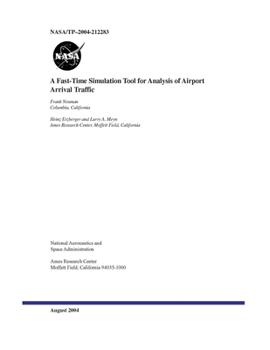
A Fast-Time Simulation Tool for Analysis of Airport Arrival Traffic
No Customer Reviews

The basic objective of arrival sequencing in air traffic control automation is to match traffic demand and airport capacity while minimizing delays. The performance of an automated arrival scheduling system, such as the Traffic Management Advisor developed by NASA for the FAA, can be studied by a fast-time simulation that does not involve running expensive and time-consuming real-time simulations. The fast-time simulation models runway configurations, the characteristics of arrival traffic, deviations from predicted arrival times, as well as the arrival sequencing and scheduling algorithm. This report reviews the development of the fast-time simulation method used originally by NASA in the design of the sequencing and scheduling algorithm for the Traffic Management Advisor. The utility of this method of simulation is demonstrated by examining the effect on delays of altering arrival schedules at a hub airport. Erzberger, Heinz and Meyn, Larry A. and Neuman, Frank Ames Research Center NASA/TP-2004-212283, A-0412029 AIR TRAFFIC CONTROL; AIRPORTS; ALGORITHMS; COMPUTERIZED SIMULATION; ARRIVALS; SCHEDULING; RUNWAYS; AUTOMATION; FLIGHT TIME; HISTOGRAMS; TIME LAG
Format:Paperback
Language:English
ISBN:B08FP7LHHW
ISBN13:9798674089049
Release Date:January 1
Publisher:Independently Published
Length:54 Pages
Weight:0.33 lbs.
Dimensions:0.1" x 8.5" x 11.0"
Customer Reviews
0 rating
Copyright © 2026 Thriftbooks.com Terms of Use
| Privacy Policy | Do Not
Sell/Share My Personal Information | Cookie Policy | Cookie Preferences | Accessibility Statement
ThriftBooks® and the ThriftBooks® logo are registered trademarks of Thrift Books Global, LLC
ThriftBooks® and the ThriftBooks® logo are registered trademarks of Thrift Books Global, LLC
