


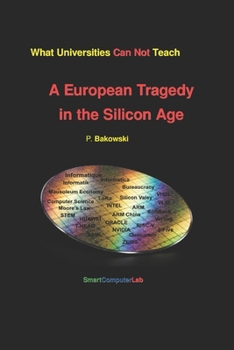
A European Tragedy in the Silicon Age
No Customer Reviews

This book explores the historical, cultural, and structural factors behind Europe's troubled relationship with modern computing. It begins with the emergence of Informatics in Europe, a discipline rooted in logic, algorithms, and formal methods that developed largely independently of semiconductor physics and hardware engineering. Consequently, when the silicon revolution began, Europe possessed strong scientific foundations but lacked the industrial ecosystem needed to capitalize on them. The narrative contrasts this with the United States, where computer science, electrical engineering, semiconductor manufacturing, and entrepreneurship evolved together. Silicon Valley's integrated ecosystem produced the first microprocessors and established a model of innovation that continues to underpin global technological leadership.
The rise of fabless semiconductor companies further shifted value toward scalable design and manufacturing ecosystems. Although ARM, a British company, became the dominant processor architecture for mobile and embedded systems, its success did not spark a broader European semiconductor renaissance. Instead, Europe steadily lost industrial leadership, culminating symbolically in ARM's 2016 acquisition by SoftBank. This decline is reflected in a striking paradox. Europe is home to ASML, the sole manufacturer of extreme ultraviolet (EUV) lithography systems essential for producing the world's most advanced chips, yet it lacks comparable leading-edge fabrication capacity. Europe mastered the critical manufacturing tools but not the industrial ecosystems that deploy them. The book also examines Europe's universities, which remain world leaders in computer science and engineering but increasingly see their graduates and researchers join major semiconductor and AI companies in the United States and Asia. This talent outflow is reinforced by foreign-owned R&D centers that conduct cutting-edge research in Europe while much of the resulting industrial value is created abroad. Finally, the book considers RISC-V, the open instruction set architecture that offers Europe a new opportunity to strengthen technological sovereignty. However, without coordinated industrial policy, sustained investment, and integrated hardware-software ecosystems, Europe risks missing this opportunity as well. From the birth of Informatics to the silicon age, from ARM and ASML to RISC-V, this book traces the forces behind Europe's technological decline and highlights a central contradiction: Europe continues to generate world-class research and enabling technologies, yet too often fails to convert them into industrial leadership, economic value, and long-term digital sovereignty.
The rise of fabless semiconductor companies further shifted value toward scalable design and manufacturing ecosystems. Although ARM, a British company, became the dominant processor architecture for mobile and embedded systems, its success did not spark a broader European semiconductor renaissance. Instead, Europe steadily lost industrial leadership, culminating symbolically in ARM's 2016 acquisition by SoftBank. This decline is reflected in a striking paradox. Europe is home to ASML, the sole manufacturer of extreme ultraviolet (EUV) lithography systems essential for producing the world's most advanced chips, yet it lacks comparable leading-edge fabrication capacity. Europe mastered the critical manufacturing tools but not the industrial ecosystems that deploy them. The book also examines Europe's universities, which remain world leaders in computer science and engineering but increasingly see their graduates and researchers join major semiconductor and AI companies in the United States and Asia. This talent outflow is reinforced by foreign-owned R&D centers that conduct cutting-edge research in Europe while much of the resulting industrial value is created abroad. Finally, the book considers RISC-V, the open instruction set architecture that offers Europe a new opportunity to strengthen technological sovereignty. However, without coordinated industrial policy, sustained investment, and integrated hardware-software ecosystems, Europe risks missing this opportunity as well. From the birth of Informatics to the silicon age, from ARM and ASML to RISC-V, this book traces the forces behind Europe's technological decline and highlights a central contradiction: Europe continues to generate world-class research and enabling technologies, yet too often fails to convert them into industrial leadership, economic value, and long-term digital sovereignty.
Format:Paperback
Language:English
ISBN:B0H7MQCB66
ISBN13:9798185550854
Release Date:July 2026
Publisher:Independently Published
Length:172 Pages
Weight:0.52 lbs.
Dimensions:0.4" x 6.0" x 9.0"
Customer Reviews
0 rating
Copyright © 2026 Thriftbooks.com
Terms of Use | Privacy Policy | Do Not Sell/Share My Personal Information | Cookie Policy | Cookie Preferences | Accessibility Statement
ThriftBooks ® and the ThriftBooks ® logo are registered trademarks of Thrift Books Global, LLC
ThriftBooks ® and the ThriftBooks ® logo are registered trademarks of Thrift Books Global, LLC
