
Skip to content
Scan a barcode
Scan
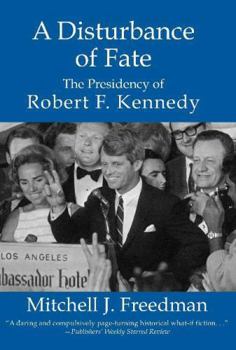
Paperback A Disturbance of Fate, the Presidency of Robert F. Kennedy Book

ISBN: 159687385X

ISBN13: 9781596873858

A Disturbance of Fate, the Presidency of Robert F. Kennedy

Select Format

Select Condition ThriftBooks Help Icon

Recommended

Format: Paperback

Condition: Very Good

$25.89
Save $11.11!
List Price $37.00
Almost Gone, Only 1 Left!

Book Overview

"A daring and compulsively page-turning historical what-if fiction. . . A remarkably realistic alternative world story. . . Unapologetically opinionated, challenging, and thought provoking."-Publishers Weekly"I am simply blown away by the imagination and scholarship that has gone into Mitchell Freedman's fabulous novel, A Disturbance of Fate. Incredibly, Freedman pulls off this historical fantasy and tells a truly fascinating, though very controversial, tale."-Dan E. Moldea, author of The Killing of Robert F. Kennedy"A Disturbance of Fate is fun and imaginative. It presents a fascinating extrapolation from what we know about our history and reaffirms the importance of Robert F. Kennedy's legacy and vision."-Peter Edelman, author of Searching for America's Heart: RFK and the Renewal of Hope, and legislative assistant to Senator Robert F. Kennedy"A Disturbance of Fate is a powerful and creative work of social realism."-Dr. Kevin Starr, State Librarian of California and award-winning author of the series, Americans and The California Dream"Whether you agree with Mitch Freedman's political views or not, his book is an exciting and imaginative exercise in what could have been."-The late Alan W. Bock, senior editorial writer, Orange County Register and author of Waiting to Inhale: The Politics of Medical MarijuanaEnter a history where Robert F. Kennedy was never killed, and where he went on to win the Presidency of the United States of America. Contrary to what some may believe, the time in which RFK survives is not tidy and perfect; it is not the utopia that many of his supporters have come to believe over the years.As in life, this daring alternate history twists and turns at the surprises and ironies along the way. Drawing from political, economic, and cultural trends to paint a realistic vision of what might have been, A Disturbance of Fate is guaranteed to leave you thinking about the fluidity of history." Freedman's] is a bold . . . look at a vital era, when many roads seemed possible."-Los Angeles Times Magazine"A Disturbance of Fate is more than a 'disturbance.' The book weaves a tale that transcends the end of an era...The portrayal of Robert Kennedy is at once, painful, yet undeniably picturesque."-The late Paul Conrad, three-time Pulitzer Prize winning political cartoonist for the Los Angeles Times"Mitchell Freedman's A Disturbance of Fate is a novel of marvels: offering readers a gripping political narrative, vividly realized in every detail, Freedman invites us to imagine an alternate universe whose origins lie in the epochal year of 1968 and whose fate is as strange and surprising as history itself."-Michael Berube, president-elect, Modern Language Association; Joseph Paterno Professor of Literature and Cultural Studies, Penn State University, and author of Higher Education Under Fire: Politics, Economics and the Crisis of the Humanities "...(A) radically different...(and) ambitious view of what would have happened had Robert Kennedy lived...It deals with...every domestic and foreign issue, and twenty-plus years of alternate American history following Robert Kennedy's election in 1968." -Jeff Greenfield, author of Then Everything Changed: Stunning Alternate Histories of American Politics: JFK, RFK, Carter, Ford, Reagan and distinguished political reporter for CBS NewsMitchell J. Freedman has history and political science degrees from Rutgers University and a law degree from California Western School of Law. He has been published in newspapers and journals on historical, political, and constitutional issues. He lives with his wife and two children in Southern California.

Customer Reviews

5 ratings

shockingly good

National Health Insurance, minimal poverty, a non- belligerent foreign policy, computers in most homes in the 1970's, no cable TV or CD's, racial harmony, Ronald Reagan and The GOP the leaders on abortion and gay rights, all these and more surpises await in the gripping, progressive "what if" novel, DISTURBANCE OF FATE. WHAT IF Robert Kennedy is not killed after the California primary. Mitchell Freedman weaves an exciting and bold tale of a timeline without a President Nixon, wihtout 30,000 more Americans killed in Vietnam, without dependence on foreign oil, and with a much more humane FBI and CIA. From Fidel Catro campaigning for president of Cuba, to Jesse jackson running for Vp as a Republican, Freedman takes actual kernels of truths and develops a farflung alternate reality. Painting Robert Kennedy realistically and often as the moderate slowing down the forces of progress, Freedman effectively demonstrates that the course taken in the world and our lives these last four decades could have been quite different. The two central issues in the Kennedy timeline are worker's rights and foreign policy. Using the power of the federal government to expand racially integrated unions in the South and throughout the country, Kennedy embarks on a new civil rights movement. A movement which makes workers more affluent and in a trickle up economy substantially eradicates poverty. One recalls the Nafta Debate between Ross Perot and Al Gore, which seems like the last time globalization in the name of multinational corporations was debated. What now is ingrained in our daily lives through Chinese imports, dollar stores and Nike sneakers stitched together by a 10 year old for a penny a day was at one time debated in this country. Supported by Kennedy and federal troops the US labor unions become so powerful there is no outsourcing of jobs, rather worker's rights are supported throughout the world especially in Latin and South America. Foreign policy changes are just as stark. Allende is not assasinated. The Shah of Iran is not allowed to rule his country with an iron fist of US support, South America moves to the left in the 1970's not in opposition to the US but in conjuction with the US. The CIA and right wing corporations are stopped from imposing their will on foreign nations. Faced with a progressive capitalist US, Cuba the Soviet Union and China all move in varying degrees to a more open democratic society in the 1970's. The 2011 report which closes the book, recounts a bizarre alternate history of the 1980's that is less grounded in facts than the rest of the book, but remains fascinating. For those of us who saw Obama as a Kennedy-like progressive, Disturbance of Fate illustrates the lost opportunity for qualitative change may be upon us again not due to a killing, but due to the timidity and conservative appointees and policies of the Obama administration to date. Hopefully this lost opportunity for fundamental change, the mantra of th

Review of A Disturbance of Fate by Mitchell Freedman

Harold Bloom in HOW TO READ AND WHY argues that there are pleasures worth seeking in difficult books. Bloom's argument is an odd, atavistic plea, yet one that challenges a basic premise shared by many. Bloom's appeal is aimed at many modern readers who he perceives to have no patience for any book that interferes with the reading equivalent of the "easy listening" musical experience. Bloom tries to make the case that there are hidden pleasures even for the typical modern reader in the great writers of the past, Shakespeare and Milton for example, that justify the effort needed to wade through archaic language or to make sense of arcane metaphors and symbolism. I am reminded of Bloom's argument after reading a review of A DISTURBANCE OF FATE that criticized the book because it is not easy enough to read and not sufficiently entertaining to be considered "literature." The truth is A DISTURBANCE OF FATE is not, and is not intended to be, an easy book to read. For those able to read seriously and expansively, and willing to make the effort, however, A DISTURBANCE OF FATE reveals itself to be an extraordinary book that engages readers on many levels. As such, the book is not intended to entertain in the same way we expect books by William Gibson and Stephen King to entertain us. Readers inclined to "easy listening" will find themselves overwhelmed by the breadth of scholarship in the book and impatient and mentally harassed by the book's intricacies and detail. Such readers may get hung up on superficial aspects of the narrative and will vent their frustration at its complexities by trying to dismiss the book in simpleminded ways, by claiming, for example, it is "doctrinaire leftism" or "retro labor radicalism." A DISTURBANCE OF FATE is far too expansive and multifaceted to be reduced to the glib soundbites of chat-group one-upmanship. On one level, the book is an imaginative "what if" exercise: What might have happened if Bobby Kennedy had not been assassinated in 1968 and had gone on to become President? There are many ways one might explore what America might have looked like after eight years of Kennedy in the White House, as opposed to eight years of Nixon and Ford; in A DISTURBANCE OF FATE the prospect is explored in the broadest manner possible. Some might suggest that this exploration is a liberal fantasy but to do so is a little like accusing an anthropologist of male chauvinism because the anthropologist has done fieldwork in a patriarchal culture. To the contrary, A DISTURBANCE OF FATE raises the intriguing specter that current boundaries of political partisanship may have evolved quite differently under a different political lineage.On a more interesting level, A DISTURBANCE OF FATE forces us, as American citizens, to confront the historical pessimism that pervades so much current American political discourse on both sides of the political spectrum. Clifford Geertz attributes such pessimism to those who "stoutly insi

Real history for our time

"A Disturbance of Fate" is a deeply researched and thorough analysis of the political environment of the late 1960's, and the consequences that might likely have happened had Robert F. Kennedy gone on to win the Democratic primary and presidency in 1968. With amazing detail and an entertaining ear for dialect, Freedman introduces us to a wide variety of major personalities during the mid- to late-20th Century and reveals their relevance to our present-day lives and, more particularly, our modern political scene. Having achieved the Presidency, RFK is faced with fulfilling his first and most important campaign promise - to bring US troops home from Vietnam. This proceeds in a way that is consistent with RFK's personality, both his politically calculating side and his side that spoke to his haunting need to realize his brother's best visions. RFK begins by mobilizing support from Republicans and hawkish Democrats, assuring (and subtly reorganizing) a deeply suspicious and resentful military, and orchestrating diplomatic missions with not only the Vietnamese, but other involved nations. The outcome is never clear, because Freedman does not neglect to deal with the setbacks and inevitable unforeseen consequences of such a complex undertaking. The early de-escalation of Vietnam marks a powerful new direction in US foreign policy, although what follows is anything but appeasement of Communist adventurism. There is, instead, the freedom for the US to pursue global policies that more closely track our democratic principles. In an atmosphere of reduced threat, many of the world's dictators find it more difficult to play the super powers against each other. Within the lively narrative descriptions, Freedman gives us a close and personal picture of the Soviet, Chinese, and other foreign leaders as they cope with and adapt to America's new leadership. Vietnam, in fact, becomes a continuing touchstone throughout those aspects of the book dealing with foreign affairs. What happens in Vietnam after the de-escalation also becomes part of a larger historical thread that makes the book powerfully thought-provoking. In that larger thread, as in Vietnam, very little goes smoothly or as predictable as one might suppose, though the book's achievement is in the historical thread's believability and its "inevitableness" once various events occur.RFK pursues his domestic agenda with the same systematic, hardball style that got him to the Presidency. But do not expect a left wing utopia, for Freedman's RFK, as in real life, must often compromise or shift gears as he pursues various initiatives. And while the political and cultural consequences are often surprising, they are never unbelievable and almost always enlightening."A Disturbance of Fate" is a relevant and an inspiring work that challenges us to consider that politics need not only be a cynical, manipulative process that ends up serving the needs of the most privileged. Instead, it boldly sets forth the

A Look At A World That Might Have Been

Mitchell J. Freedman's "A Disturbance of Fate," which tells the tale of a world in which Robert Kennedy was not assassintated in June of 1968, but went on to serve two terms in the presidency, is a different sort of alternate history book. The standard formula, as typified by Robert Harris' "Fatherland," or Harry Turtledove's works, highlights the stories of fictional characters, usually minor players in the sweep of history, but whose lives are shaped by the changed circumstances of their worlds. Freedman's book reads more like a scholar's history of the RFK administration. He goes into impressive depth to describe the changed politics and culture of a world in which RFK had lived. The breadth and depth of his study is quite impressive, as he lays out a very different United States and a radically changed world. The changes turn out mostly, but not exclusively, to be for the better. In these pages, you will find out how a President RFK quickly disentangled the nation from the Vietnam conflict; how his administration nurtured a renewal of the labor movement; how young radicals who fought the war in the real-life timeline instead channeled their energies into labor organizing and national service in what the author calls the "RFK timeline." There are more than a few surprises...such as the Republican party's emergence as the champion of legal abortion and gay rights while the Democrats become more conservative on social issues. I did have one quarrel with this otherwise excellent book. In an attempt, no doubt, to give the dialogue a more realistic feel, Freedman has President Johnson and RFK Vice President Ralph Yarbrough speaking in pronounced southern drawls; Chicago's Mayor Daley is a classic "dese and dose" sort of guy. Yet President Kennedy never once refers to "Cuber" or pursuing policies with "vigah." Hmmm.... But that's a minor annoyance in what is an exhaustively researched, deeply felt story. Anyone with an interest in the politics of the sixties, and especially those who admired RFK and continue to feel a sense of loss at his senseless murder, should find this to be a thought-provoking read.--William C. Hall

Boomer' s Alert

For anyone who either lived through the 60's or are fascinatedby this era as I am, this book "A Disturbance of Fate" is amust read. Mr. Freedman subtley blends the fiction of "what if"with the hard facts as they actually happened.The end result is a thoroughly provocative book that is difficult to put down. The author's imagination and flare areastounding.Also reccomended for political junkies and anyone who justenjoys a good story.
Copyright © 2026 Thriftbooks.com Terms of Use | Privacy Policy | Do Not Sell/Share My Personal Information | Cookie Policy | Cookie Preferences | Accessibility Statement
ThriftBooks® and the ThriftBooks® logo are registered trademarks of Thrift Books Global, LLC

GoDaddy Verified and Secured