


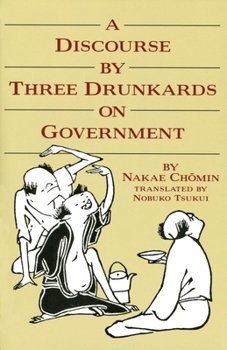
A Discourse by Three Drunkards on Government


Select Format
Select Condition 
Book Overview
Nakae Chomin's Discourse by Three Drunkards on Government offers a captivating glimpse into a nation grappling with modernization and the adoption of Western-style governance. Through the spirited discussions of three distinct characters--the Gentleman of Western Learning, the Champion of the East, and the enigmatic Master Nankai who loves nothing more than to drink and argue politics--Chomin skillfully navigates the competing visions and ideologies that were shaping Japan's future. Each character embodies complex and often contradictory aspects of the author's own worldview, challenging readers to engage deeply with the nuances of Meiji-era political thought. The discussion's drinking bout context allows Chomin to freely debate political issues to offer an astute analysis of contemporary European politics and a prophetic vision of Japan's direction. Readers will gain insight into the dilemmas faced by Meiji intellectuals as they sought to reconcile the demands of progress, nationalism, and democracy. The Gentleman advocates for democratic freedoms and Enlightenment ideals, while the Champion embraces a pragmatic, nationalist perspective focused on military might. Master Nankai's measured critique offers a balanced approach, emphasizing gradual political reform and the importance of aligning changes with the will and intellectual level of the people. The rich tapestry of ideas not only illuminates the historical context but also invites readers to reflect on timeless questions of governance, national identity, and the role of the individual in shaping history. This book is not just a historical account but a thought-provoking dialogue that challenges readers to consider the intricate interplay between ideas, actions, and the inexorable march of history.
Format:Paperback
Language:English
ISBN:0834801922
ISBN13:9780834801929
Release Date:October 1992
Publisher:Weatherhill
Length:144 Pages
Weight:0.63 lbs.
Dimensions:0.4" x 5.4" x 7.5"
Customer Reviews
2 ratings
Brief and revealing
Published by Thriftbooks.com User , 22 years ago
This short work, from the end of the 19th century, taught me a lot about Japan's course since then. Two disputants, under blanket amnesty granted by brandy, present supposedly opposing views. The first, in Western clothes, orates at length on democracy, personal freedom, education, world relations, and (of course) national wealth. The second, representing Japanese tradition, argues for military expansionism in order to attain a secure place in international politics and (of course) to attain national wealth.I say supposed opposition - it seemd to me that the two were really discussing different aspects of the cultural identity. The master, in the end, advises modernization within reason and defensive armament within reason. Although his house set the stage for the other two and his point made the most sense, I found it the least interesting part of the text. The two extremes held my attention much more closely. In retrospect, we can see that Japan has followed both courses. It armed heavily up to mid 20th century, and has since participated on an even footing with the major Western powers. This book seems have predicted both. I don't know whether to file this little book closer to Confucius or Johnathan Swift - no matter, I welcome it to my library.
A Pre-war subversive missive which has excellent relevancy
Published by Thriftbooks.com User , 24 years ago
The Discourse here is an excellent pre-war subversive missive which will give significant insight to those who wish to understand the underlying internal soul-searching going on in Japan during the period between the arrival of Perry and the Black Ships until the modern soul-searching debate surrounding the essential illegality and absurdity of Article IX in the Japanese Constitution. The title itself should clue in the reader that this is definitely one of those books which like Voltaire and Machiavelli, got the author in quite a bit of trouble with the secret police for being too close to the truth for thier liking. The debate takes on a similar form to the traditional greek diatribes in that it is in the form of a conversation between master and seekers. However, the Discourse here is a conversation between the Master Power Drinker and two drinking buddies; The Lover of the Old and the Lover of the New. After the boys have had a few bottles of sake a piece, and are "full of thier cups" as it were, they are allowed to speak thier minds freely in the Japanese tradition as a Jester is with his cap. Hence, the drinking becomes a token of the true face of each of the debaters and the heated philosophical arguements that always insue after one has had enough to drink as to become loquatious, but not yet enough to slur one's words, yet what is said cannot be held against the speakers the next day as they try to sleep off thier hangovers. Anyone interested in the essential debate for the Japanese soul as Japan moved from a fuedal isolationist society to dreams of empire in complete immitation of the British and United States empires should certainly read this book.
Copyright © 2026 Thriftbooks.com Terms of Use
| Privacy Policy | Do Not
Sell/Share My Personal Information | Cookie Policy | Cookie Preferences | Accessibility Statement
ThriftBooks® and the ThriftBooks® logo are registered trademarks of Thrift Books Global, LLC
ThriftBooks® and the ThriftBooks® logo are registered trademarks of Thrift Books Global, LLC
