


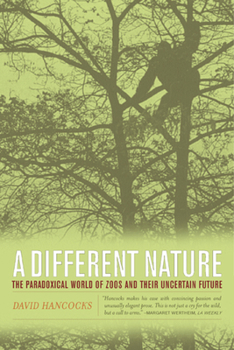
A Different Nature: The Paradoxical World of Zoos and Their Uncertain Future

Select Format
Select Condition 
Book Overview
Humanity has had an enduring desire for close contact with exotic animals--from the Egyptian kings who kept thousands of animals, including monkeys, wild cats, hyenas, giraffes, and oryx, to the enormously popular zoological parks of today. This book, the most extensive history of zoos yet published, is a fascinating look at the origins, evolution, and--most importantly--the future of zoos.
David Hancocks, an architect and zoo director for thirty years, is passionately opposed to the poor standards that have prevailed and still exist in many zoos. He reviews the history of zoos in light of their failures and successes and points the way toward a more humane approach, one that will benefit both the animals and the humans who visit them. This book, replete with illustrations and full of moving stories about wild animals in captivity, shows that we have only just begun to realize zoos' enormous potential for good.
Hancocks singles out and discusses the better zoos, exploring such places as the Arizona-Sonora Desert Museum, the Bronx Zoo with its dedication to worldwide conservation programs, Emmen Zoo in Holland with its astonishingly diverse education programs, Wildscreen in England, and Seattle's Woodland Park Zoo, where the concept of "landscape immersion"--exhibits that surround people and animals in carefully replicated natural habitats--was pioneered.
Calling for us to reinvent zoos, Hancocks advocates the creation of a new type of institution: one that reveals the interconnections among all living things and celebrates their beauty, inspires us to develop greater compassion for wild animals great and small, and elicits our support for preserving their wild habitats.
David Hancocks, an architect and zoo director for thirty years, is passionately opposed to the poor standards that have prevailed and still exist in many zoos. He reviews the history of zoos in light of their failures and successes and points the way toward a more humane approach, one that will benefit both the animals and the humans who visit them. This book, replete with illustrations and full of moving stories about wild animals in captivity, shows that we have only just begun to realize zoos' enormous potential for good.
Hancocks singles out and discusses the better zoos, exploring such places as the Arizona-Sonora Desert Museum, the Bronx Zoo with its dedication to worldwide conservation programs, Emmen Zoo in Holland with its astonishingly diverse education programs, Wildscreen in England, and Seattle's Woodland Park Zoo, where the concept of "landscape immersion"--exhibits that surround people and animals in carefully replicated natural habitats--was pioneered.
Calling for us to reinvent zoos, Hancocks advocates the creation of a new type of institution: one that reveals the interconnections among all living things and celebrates their beauty, inspires us to develop greater compassion for wild animals great and small, and elicits our support for preserving their wild habitats.
Format:Paperback
Language:English
ISBN:0520236769
ISBN13:9780520236769
Release Date:December 2002
Publisher:University of California Press
Length:301 Pages
Weight:0.97 lbs.
Dimensions:0.9" x 6.0" x 9.0"
Customer Reviews
4 ratings
almost good
Published by Thriftbooks.com User , 16 years ago
A lot about the history of zoos and their evolving design- but not much else. The author is pro zoo and tells a bit about what is wrong w/ zoos, but nothing really about why they're justified. I'm anti-zoo myself, but I would have liked more information on the pros and cons of zoological gardens for thought rather than so much written on their design alone.
Superb! Knowledge, scope, logic, and honesty is excellent, clear & concise.
Published by Thriftbooks.com User , 20 years ago
When I first opened up this book, I skipped to the last couple of chapters as I had read a couple of other books on zoos recently, I didn't think I would want to read the first few chapters as it would be repetitive information from the others - I ended up going to the start and reading the whole book, in I realized early on that the author knows his stuff when I read a single paragraph in one of the later chapters where he identified quite possibly the best zoo in the world - The Singapore Zoo and Night Safari. A zoo I visited in late 2003 - which surprised me as being quite innovative, and impressively landscaped, and designed. (Author also highlights the Costa Rica ZooAve, Belize Zoo, and Tuxtle Guiterrez, Mexico zoo - I haven't been to any of these) As an extensive traveler and scuba diver, I dislike zoos intensely, aquariums less so. The difference between making the effort to see an animal in the wild versus at a zoo like a checklist is to put it mildly - like night and day. This author understands it. (Though I was quite impressed by Singapore's night safari concept - also heard of a night one in Malaysia - though not been yet. Many animals are more active at night.) I've been to a handful of zoos and aquariums, most of them recently in support of a project - but they are "among the best" - San Diego, Seattle's Woodland Park, and aquariums - Monterey Bay, Seattle, and Osaka, Japan and a couple of others that are shameful - Tacoma Zoo, Monte Carlo aquarium. I hope I never visit one again - save for a few, countable on one hand, that the author highlights. Mr. Hancocks gives a short, but concise overview on the history of zoos / animal keeping - starting from Egypt to the present day - how they evolved and how they are changing / "improving." His detailed knowledge of specific exhibits types globally, and the fallacy of zoo "conservation" efforts is impressive to say the least. He also talks about what zoos, bioparks, or museums might look like in the future, and what their future role should / can be, and even why they fall short of better examples today. He does offer both praise and criticism. He notes the irony of many zoo initiatives. I can't recommend this book any higher. This easily vaults into one of the best non-fiction books I've ever read. Instead of zoos, how about building cities of harmony? In Nara, Japan, a modern town of 365k, 1,200 deer roam freely. There is a yearly ceremony where the antlers are cut off, otherwise they roam around in a large central park, unfenced. Accidents with cars are few due to walkable streets and low speed car traffic. Additional books I recommend: Life at the Zoo - perspective from a zoo veterinarian - though his logic is not quite as sound as Mr. Hancocks, nor is his knowledge of zoos around the world. Good writing style though, attentive to details, and easy to read bibliography (Which is how I found - A Different Nature). Keepers of the Kingdom:New American Zoo - Coffee table style b
from the Science review
Published by Thriftbooks.com User , 24 years ago
See the excellent review of this book in the journal, Science (Vol. 292, page 1304, 18 May 2001), by Michalel H. Robinson, the former director of the US National Zoo. The role of zoos is normally conceived of as fourfold: to promote recreation, education, research and conservation. He concludes that, in fact, only the very best zoos realize this potential. How many visitors, for example, leave a zoo knowing more about animal needs or their native habitats than when they entered? This reflects a failure of zoological parks to promote "biological literacy." Part of the problem is the frequent catering of zoological parks to show off charismatic vertebrates to humans desiring to see them. Yet it is increasingly recognized that effective conservation must be ecological in scope and based on large-scale "in situ" preservation of habitats. This book calls for a new vision of Zoological Gardens, to help save the world around us.
If You Like Animals Even a Little, Read This Book
Published by Thriftbooks.com User , 24 years ago
David Hancocks has a lot of bad things to say about zoos - but he doesn't come at it from a wing-nut "zoos are evil" perspective. He criticizes them, justifiably and intelligently, for doing a poor job. As he sees it, zoos should be able to help animals and truly educate people about nature (of which fauna are just one part), but most often they don't do so well enough.He goes through the history of zoos, from ancient menageries to Disney's Animal Kingdom, and shows how that history relates to political, religious and scientific trends. He explains lucidly how zoos should (and sometimes do) interlock zoology with conservation, botany, geology, architecture and other fields. He doles out praise to various institutions when merrited - which is in several cases, but sadly, far outweighed by the times when zoos have failed. It's time to start doing a better job, while there's still time.This book will give you a lot of food for thought, and make you see animals and nature and zoos in a new light. It will makes you see zoos' flaws, but also their potential.
Copyright © 2025 Thriftbooks.com
Terms of Use | Privacy Policy | Do Not Sell/Share My Personal Information | Cookie Policy | Cookie Preferences | Accessibility Statement
ThriftBooks ® and the ThriftBooks ® logo are registered trademarks of Thrift Books Global, LLC
ThriftBooks ® and the ThriftBooks ® logo are registered trademarks of Thrift Books Global, LLC
