


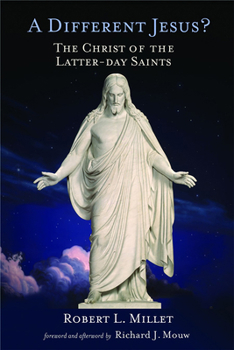
A Different Jesus?: The Christ of the Latter-Day Saints

Select Format
Select Condition 
Book Overview
Foreword and afterword by Richard J. Mouw Are Latter-day Saints Christian, or do they worship a different Jesus? In this engaging book based on the foundational Mormon documents, Robert Millet clearly... This description may be from another edition of this product.
Format:Paperback
Language:English
ISBN:0802828760
ISBN13:9780802828767
Release Date:April 2005
Publisher:William B. Eerdmans Publishing Company
Length:226 Pages
Weight:0.82 lbs.
Dimensions:0.7" x 6.1" x 9.0"
Customer Reviews
5 ratings
Solid, Thorough, and Accurate Examination
Published by Thriftbooks.com User , 16 years ago
This is another fantastic work in a long line of Robert Millet's writings. In his traditional manner, the book is a solid, thorough, and accurate examination of the subject. It is also written in a user-friendly and insightful way. Definitely "five stars" from me.
An unanswerable vindication of LDS Christology/soteriology
Published by Thriftbooks.com User , 16 years ago
I wish to direct the attention of all readers to the inane drivel spewed so copiously forth by the scandal-mongering, agenda-driven reviewers who assigned a one- or two-star rating to this book. I would have all consider not only the dearth of quotations from the actual book in such negative reviews, but the dishonestly partial use of what few quotations were presented. Straining at the merest gnats, these casuistic, camel-swallowing detractors reveal a spirit that could as easily be turned from an assault on Mormonism to an open attack on the Bible itself. Objection is made against the author's conception of Jesus as the firstborn of our Father in Heaven. And yet this doctrine finds support at once in the New Testament (Romans 8:29, Colossians 1:15) and, to those attuned to the Spirit of Truth, the Old (Numbers 18:15). Indeed, no one can claim membership in the body of Christ who denies His status as the firstborn (see Hebrews 12:23), and thus these critics in their purblind zeal reject even the very Christ. Objection is also made against the author's identification of Jesus as a Brother. Here again we find LDS doctrine vindicated in full by no less a text than the Bible (Matthew 25:40, Matthew 28:10, John 20:17). Surely it could not be otherwise, as our Heavenly Father is designated "the Father of spirits" (Hebrews 12:9), and Jesus was as much as spirit as any other being created in God's image, so that the author of the epistle to the Hebrews is in his rights to place a clear distinction between Jesus and the Father (Hebrews 1:5). Objection is also raised against the LDS doctrine of a Trinity composed of united but distinct Personages. Yet, to anyone possessed of common sense, a reading of Mark 1:11 is enough to show the soundness of such a doctrine. Only a man set on a belief that Christ was a ventriloquist par excellence could think otherwise after reading that passage. John, indeed, makes plain how the oneness of the Trinity is to be interpreted (John 17:11). Those who conceive of the Trinity as one indivisible substance would have no difficulty conceiving the same of Adam and Eve who were made "one flesh" (Genesis 2:24). Without any question, too, the vision splendid which was revealed to Stephen puts to utter silence any further controversy on the question of whether or not Jesus and His Father are one undivided substance (Acts 7:55-56). Finally, objection is foolishly raised against the origins of Mormonism as being aberrant from the origins of primitive Christianity. Nothing could be further from the gospel truth. Jesus revealed Himself to men whom He would choose as Apostles and Prophets (1 Corinthians 12:28, Ephesians 4:11). On all essential points, these lower-than-pond-scum wastrels who vilify the presentation of Mormon doctrine in this books stand at variance with the most biblical truths. We are therefore justified in dismissing once and for all Michael Lima's horribly wayward, grossly inaccurate assertion that "withou
Building Bridges?
Published by Thriftbooks.com User , 17 years ago
This book, unfortunately highly controversial in some Protestant circles, is the product of the friendship of Robert Millet, who teaches ancient scripture at Brigham Young University, and Richard Mouw, president of Fuller Theological Seminary in Pasadena, California. Its publication clearly marks a significant advance in the relationship of evangelicals and Latter-day Saints. In the past all that was available in Protestant bookstores was the badly informed, highly polemical literature written by the partisan anti-Mormon element of the countercult industry. Without realizing it, those who have turned to this literature for an understanding of the Church of Jesus Christ have done something analogous to consulting Nazi propaganda for an understanding of the faith of Jews or to old Communist propaganda for an understanding of American life and culture. Latter-day Saints can also benefit from giving careful attention to Millet's presentation of their faith to Protestants. If there is a weakness in Millet's book, it stems from his inattention to the historical elements in the faith of the Saints and thus his inattention to the sophisticated literature on the historical authenticity of the Book of Mormon. Sorting out theological issues for evangelicals, as useful as that is, still leaves the crucial truth questions bracketed. However, by publishing Millet's book, Eerdmans, a leading evangelical press, has now made available in Protestant bookstores a sound, nonpolemical presentation of the fundamentals of the faith of the Saints.
Latter-day Saints are part of the Christian community--
Published by Thriftbooks.com User , 17 years ago
I also recommend _Claiming Christ: A Mormon-Evangelical Debate_ by Robert L. Millet and Gerald R. McDermott. Pastor McDermott, who is a Lutheran pastor and college professor has concluded after careful study that, "Evangelicals and Mormons agree on lots of things about Jesus. Many evangelicals are surprised to learn, for example, that Mormons believe not only that Jesus is the Son of God but also that he is God the Son. I find that many evangelicals have somewhere picked up the idea that Mormons deny the deity of Jesus Christ. They are often amazed to learn that, unlike Jehovah's Witnesses and other groups they typically classify as "cults," which do indeed deny the deity of Christ, Mormons declare emphatically that Jesus was and is incarnate God. ... I have to say that evangelical agreement with [Mormons] on Jesus is significant and, when compared to a history of evangelical denunciations of Mormonism, remarkable." (pg. 63,64)
A Worthwhile Contribution.
Published by Thriftbooks.com User , 20 years ago
As a former evangelical of 32 years and now member of The Church of Jesus Christ of Latter-day Saints living in the heart of the bible-belt I have had many opportunities to dialogue with my evangelical brothers and sisters. Invariably when discussing our views on faith the old familiar "You follow a "different" Jesus" accusation pops up. Before getting stuck in this semantic loop I sometimes attempt to circumvent this stumbling block and get on to more fruitful interaction by initiating the following dialog and illustration. -ME: Is the Jesus that you follow the same Jesus that we read about in the New Testament? +EVANGELICAL BROTHER: "Yes" -Did this same Jesus, after his resurrection, walk, and talk and eat with his disciples in a very real and physical way? + "Yes, he did" -Sometime after this event did this same Jesus ascend in a very physical way and promise to return in the same fashion someday as was witnessed by others? + "Yes" -So this same Jesus is at this very moment located somewhere in the universe right now is he not? + "Yes, i suppose so" -Could this same Jesus come and stand here right next to us in a very real and physical way right now if he so chose? + "Yes, i suppose he could" -For the sake of illustration let's pretend that this same Jesus did in reality choose to physically be here- and that he is standing right here next to us right now. Could we not speak and interact with him in the same fashion that you and I are interacting with each other right now if he so chose to do so? + "Yes" -I could put my hand on his shoulder just like this could I not? (I literally hold my arm up as if my hand were on the shoulder of Jesus standing next to us) + "yes, I suppose you could" -You could put your hand on his other shoulder too couldn't you- For the sake of this illustration can you put your hand there? (I literally ask them to put their arm up as if their hand were on the opposite shoulder of Jesus) -I then say, with each of us having a hand on Jesus' shoulder- this is the Jesus that I follow. This is the Jesus that is testified about in the Book of Mormon. This is the Jesus whom I wholly look toward for my salvation and for forgiveness of my sins and is the "keeper of the gate". This is the Jesus in whose name I pray to the Father in. This is the Jesus at whose feet I will fall at the last day. Is this not the same Jesus that you follow? Rather than claiming we follow a "different" Jesus don't you think it would be much more accurate and more constructive if we were to agree that we do in fact follow the same Jesus- the one that is standing right here- but that we understand the same Jesus differently? If they are truly honest within themselves they will say- yes, we follow the same Jesus, but we understand the same Jesus differently. However, more times than not, within literally 1 minute back it comes- "No!, you worship a different Jesus!. The net effect of Robert Millet's "A Different Jesus?" will be that it will become incr
Copyright © 2025 Thriftbooks.com
Terms of Use | Privacy Policy | Do Not Sell/Share My Personal Information | Cookie Policy | Cookie Preferences | Accessibility Statement
ThriftBooks ® and the ThriftBooks ® logo are registered trademarks of Thrift Books Global, LLC
ThriftBooks ® and the ThriftBooks ® logo are registered trademarks of Thrift Books Global, LLC
