


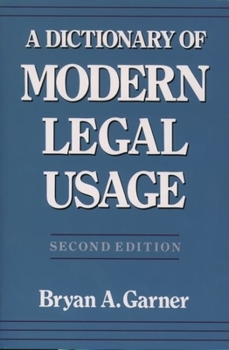
A Dictionary of Modern Legal Usage

Select Format
Select Condition 
Book Overview
Garner's Dictionary of Modern Legal Usage gives authoritative guidance on all the vexing questions that legal writers face, from correcting grammatical errors to framing legal issues to distinguishing between similar but distinct legal terms. With great detail and care, Garner explains what legalese is, how it can be simplified, and how far legal writers can go in simplifying it. The topics are alphabetically arranged for ease of reference: simply look up any phrase or grammatical category you're interested in, and you're likely to find the final word on the subject. Shortly after the completion of this massively expanded second edition, the late Charles Alan Wright said: "The first edition of this book has been praised around the world as both the most reliable guide to legal usage and the most fascinating to read. The second edition outdoes even its predecessor."
Format:Paperback
Language:English
ISBN:0195142365
ISBN13:9780195142365
Release Date:January 1
Publisher:Oxford University Press, Incorporated
Length:953 Pages
Weight:2.90 lbs.
Dimensions:5.9" x 2.0" x 8.9"
Customer Reviews
5 ratings
The Best
Published by Thriftbooks.com User , 21 years ago
This is, by far, the single best resource on legal usage one can buy. I never cease to be amazed at how often I pull this book off of my shelf to find it giving me a clear and accurate answer to a usage question. I purchased this book several years ago after attending one of Garner's legal writing seminars. That seminar and this book have dramatically improved my legal writing skills. Those two tools positively influence my writing every single day. If you follow Garner's advice and guidance, you will eliminate deadening and condescending legalese from your legal writing and replace it with clear and concise prose. My clients appreciate receiving contracts that are actually readable and my contracts are less frequently subject to alternative interpretations because ambiguities are largely eliminated. As a lawyer or paralegal, do yourself a favor and buy this book. Better yet, buy this book and take Garner's Advanced Legal Drafting seminar. You won't regret it.
Can't Live Without It
Published by Thriftbooks.com User , 23 years ago
As an editor of legal newsletters, I do not know what I would do without this absolutely necessary tool of the trade. Not only do I, a non-attorney, find it indispensible, but my colleagues who are members of the Bar are constantly borrowing my copy "just to check." And whatever they, or I, am checking--it's in there.Garner has a way of condensing solid and often very intricate information into a few paragraphs so succinct, and so informative, that anyone can understand. When one is rushing against a deadline, editing for and about attorneys and the law, reaching for Garner often makes the difference.I would give up my dictionary before I would part with this book, and I cannot recommend it highly enough. Garner has earned his place in the annals of legal writing and editing, and I hold him--and this book--in the highest esteem.
An essential companion
Published by Thriftbooks.com User , 24 years ago
A J.D., admission to the bar, and this book should be the three requirements for any individual to practice law. The title, "A Dictionary of Modern Legal Usage," is absolutely appropriate in that this book does not merely serve as an alternative to Black's to find the definition of a word or phrase. Rather, the book's emphasis is on appropriate usage. It is an enjoyable enough read that one might end up reading it from cover to cover if one isn't careful. I recommend it highly.
The indispensable authority.
Published by Thriftbooks.com User , 24 years ago
If you have a question about a legal word or about legal writing, look it up here. You'll find the answer, and you're also likely to find a lively and intelligent discussion on the point. But the best thing about DMLU2 is that it's correct. So use it for back-up when you need to be right. Every lawyer should have it.
A reference that every lawyer should own -- and use.
Published by Thriftbooks.com User , 25 years ago
Garner should be carried shoulder-high for this work. Much expanded beyond the first edition, it provides intelligent, informed guidance on both individual terms and general topics. What does it really mean to "beg the question"? Is "struck" preferable to "stricken"? What's the plural of "cestui que trust"? Garner does not simply give thumbs up or down; he explains the pros and cons of various usages, with an outlook that is literate and, above all, practical. Time after time I find that he has anticipated my questions and has answered them with just the right level of detail.
Copyright © 2026 Thriftbooks.com
Terms of Use | Privacy Policy | Do Not Sell/Share My Personal Information | Cookie Notice | Cookie Preferences | Accessibility Statement
ThriftBooks ® and the ThriftBooks ® logo are registered trademarks of Thrift Books Global, LLC
ThriftBooks ® and the ThriftBooks ® logo are registered trademarks of Thrift Books Global, LLC
