


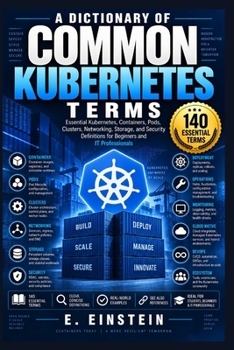
A Dictionary of Common Kubernetes Terms: Essential Kubernetes, Containers, Pods, Clusters, Networking, Storage, and Security Definitions for Beginners

Kubernetes documentation, training materials, job descriptions, and technical conversations contain specialized terminology that can feel overwhelming to newcomers. A Dictionary of Common Kubernetes Terms provides clear, concise explanations of 140 terms that students, beginners, career changers, and IT professionals are most likely to encounter.
This compact reference explains the language behind:
Kubernetes clusters and control-plane componentsContainers, Pods, Nodes, and workloadsDeployments, ReplicaSets, StatefulSets, Jobs, and DaemonSetsServices, Ingress, Gateway API, DNS, and network policiesVolumes, PersistentVolumes, storage classes, CNI, CRI, and CSIScheduling, scaling, resource requests, limits, and probesSecrets, ServiceAccounts, RBAC, and Pod securitykubectl, kubeconfig, Helm, Operators, logs, and troubleshooting statesEach entry uses approachable language and includes practical context showing how the concept appears in real Kubernetes environments. Helpful cross-references connect related terms and clarify commonly confused concepts.
Use this book while studying Kubernetes, preparing for technical conversations, reviewing documentation, learning cloud-native operations, or building confidence with container orchestration vocabulary.
A focused reference for understanding the terms, and not another oversized Kubernetes manual.Customer Reviews
ThriftBooks ® and the ThriftBooks ® logo are registered trademarks of Thrift Books Global, LLC
