
Skip to content
Scan a barcode
Scan
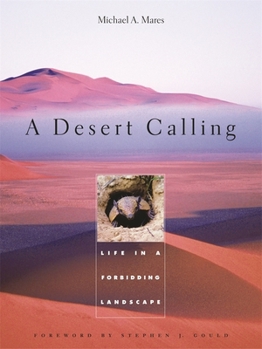
Hardcover A Desert Calling: Life in a Forbidding Landscape Book

ISBN: 0674007476

ISBN13: 9780674007475

A Desert Calling: Life in a Forbidding Landscape

Select Format

Select Condition ThriftBooks Help Icon

Recommended

Format: Hardcover

Condition: Like New

$12.89
Save $29.11!
List Price $42.00
Almost Gone, Only 1 Left!
Save to List

Book Overview

For most of us the word "desert" conjures up images of barren wasteland, vast, dry stretches inimical to life. But for a great array of creatures, perhaps even more plentiful than those who inhabit tropical rainforests, the desert is a haven and a home. Travel with Michael Mares into the deserts of Argentina, Iran, Egypt, and the American Southwest and you will encounter a rich and memorable variety of these small, tenacious animals, many of them first discovered by Mares in areas never before studied. Accompanying Mares on his forays into these hostile habitats, we observe the remarkable behavioral, physiological, and ecological adaptations that have allowed such little-known species of rodents, bats, and other small mammals to persist in an arid world. At the same time, we see firsthand the perils and pitfalls that await biologists who venture into the field to investigate new habitats, discover new species, and add to our knowledge of the diversity of life.

Filled with the seductions and trials that such adventures entail, A Desert Calling affords an intimate understanding of the biologist's vocation. As he astonishes us with the range and variety of knowledge to be acquired through the determined investigation of little-known habitats, Mares opens a window on his own uncommon life, as well as on the uncommon life of the remote and mysterious corners of our planet.

Customer Reviews

4 ratings

The Mysterious Deserts of our Earth

Michael Mares is the Director of the Sam Noble Oklahoma Museum of Natural History, as well as Curator of Mammals at that institution. During his earlier career he spent many years in the back country of the planet's deserts studying the smaller mammals of these dry and often desolate ends of the earth. The years he invested in advancing our knowledge of what some might call mere mice and rats (as well as bats and armadillos) could not be easily repeated. Indeed his important work on Old World desert rodents came to an abrupt halt with the fall of the Shah and the invasion of Afghanistan by the Soviet Army. If anything, the situation is much worse, with not only war and political unrest, but the suspicion of many governments (not totally unjustified in a very few extreme cases) that any field biologist might be a bioengineering pirate who will not just take specimens, but patentable biological products. The stories of Mares' field work in such remote areas as the desert near Andalaga in Argentina, the Dasht-i-Kavir in Iran,the Sahara near Giza in Egypt, and the back country of Brazil, are well-told in "A Desert Calling: Life in a Forbidding Landscape". This is a fascinating journal of a field biologist who has discovered several new species and subspecies of mammals and documented numerous details of their lives and of the lives of known species whose ecology and life histories were an almost total blank. Such research is certainly not without danger, as any field biologist knows. Floods, snakes, dangerous people, heat, bad roads, etc. all take their toll. I call myself a field biologist because most of my work has been based in the field as opposed to laboratory, but I (as Stephen J. Gould says of himself in the Forward) am the meanest piker compared to Mares! I never spent months in the field in some almost inaccessible part of South America, but I suspect few biologist have done what Mares has accomplished in this regard. The fact (as Gould notes) that the book is almost totally about Mares' field work as opposed to his administrative role, speaks volumes about the true field biologist that Mares is. Mares spins a wonderful tale of scientific discovery in a world that is rapidly vanishing because of human population pressures and the demands of consumers in the developed and developing World. We may never see its like again. If you would know what this research, often denigrated by politicians as a waste of public monies, really entails and what it really means to human knowledge of the planet, read this book.

Desert adventures with biology

It is interesting that this book is being published for the first time since much of the material comes from Professor Mares's work with small desert mammals during the seventies. Mares, who is the Curator of Mammals and Director of the Sam Noble Oklahoma Museum of Natural History at the University of Oklahoma is also the author of Encyclopedia of Deserts (1999). Perhaps he has been too busy to publish what is essentially a popular work. Since the book includes reports on his field work and that of his students into the nineties, maybe this book is a way of rounding out a career.Regardless of the reason for the material finally finding publication, we are the better for it. Part memoir, part fieldwork journal, and part travelogue, A Desert Calling is that rare scientific tome that engages our adventurous spirit through a vivid and lively presentation while at the same time giving us a concrete sense of the animals and their habitats. As the late Stephen Jay Gould expresses it in the Foreword, Mares writes with "a verbal freshness (and a fine sense for a good yarn) that will delight even the most sophisticated urbanite...." (p. xi)The book is also beautifully edited and presented with handsome page layouts. Chapter beginnings and major paragraph breaks feature photo icons of the small desert rodents that were the focus of much of Mares's work. The text is interspersed with black and white photos of animals and the forbidding desert climes that he and his fellow field biologists encountered on three continents. There are four maps to help us locate these places. Mares includes an appendix giving both the common and scientific names of species mentioned in the text organized geographically. There are 14 pages of suggestions for further reading ordered by chapter.Mares's travels include the Sonoran and Mojave deserts in the American southwest, the Monte Desert and the Patagonia and Caatinga regions in South America, and the Dasht-i-Kavir in Iran and the Sahara in Egypt. He traveled to Argentina during the years of the Dirty War and was in Iran just before the fall of the Shah and the rise of the Ayatollah Khomeini. He lived through blinding sandstorms and heat so oppressive that he sought relief in pig water and mud laced with pig feces. He endured stings from hoards of vicious insects in landscapes nearly as barren as the moon with shaded Fahrenheit temperatures in the 130's. (p. 181) He encountered bureaucratic obstruction that would try the patience of a saint, poverty that would move even Scrooge to tears, and enough danger to satisfy a jaded CIA agent.But above all he reports on the animals and how they live. He includes the discovery of a number of new species and genera of mammals, and three major ecological findings, all having to do with convergent evolution. Seeking the animal in the Monte Desert of Argentina that is the analogue of the kangaroo rat of the North American Sonoran Desert he inexplicably finds none. But then

Two books for the price of one

Michael Mares' book grew on me enormously as I read it. The combination of his series of wild experiences along with his enthusiasm for the research puzzles he confronts made this book read almost like a double thriller. This could be read as a travel book, very much like Eric Hansen's books, with a bonus of learning a lot about nature, evolution, ecology, etc. Or, it could be read as a book of ecology and evolution with the bonus of extraordinary adventures. At first, I kept on reading the book more for the adventures and then realized that my excitement about the science was growing. I have never had a book sneak up on me in this way.

The Beauties and Dangers of the Desert

We are quite used to hearing about the rainforest and the worries about its loss. We hear less about the loss of deserts. Let the military test there, let off-track entertainment vehicles bounce there, let toxic wastes accumulate there; they are not good for much else, goes the common view. They are uncomfortable places to visit, and they can't be turned to agriculture. Michael A. Mares, in _A Desert Calling: Life in a Forbidding Landscape_ (Harvard), has a completely different view. Mares has spent his professional life studying the deserts of the United States, Argentina, Iran, and Egypt. He undoubtedly knows plenty about plants, insects, birds, and snakes of these areas, but he is a specialist in the mammals that have evolved to live in such harsh conditions. Desert rats, mice, armadillos, and gerbils have been his study, and he has here (note the double meaning of the title) assembled a description of his life's work, as well as an attempted explanation of just why he has spent so much time in places the rest of us could not stand. His thoughtful and funny stories are a sort of autobiography, and he has much to tell us about the exotic animals that he wants better appreciated.There are some peculiar beasts out there. The kangaroo rat has a nose exquisitely tuned to find buried seeds, and can filter sixty seeds from sand in a second. There are penguins in the desert in Patagonia. There are a few rodents on different continents who can live on the leaves of the saltbush, leaves that have a protective outer layer of cells full of salt. They have special teeth, or in one case, special dental hairs, that strip away the inedible layer to get to the green below. There are deadly assassin bugs. Mares describes staying in some of the most unpleasant regions of the world, and admits that when he is busy with academia and home, he longs to get to the desert, but it works vice versa, too. He is almost killed by fungus infesting his lungs after climbing through guano deposits in a New Mexico cave. He is nearly crushed by trees falling during a storm on a bat hunt in Costa Rica. Some of the most surprising specimens described here are humans, and Mares has plenty of funny stories._A Desert Calling_ is full of light moments, and near-disasters that are pleasant to recall because they are over. However, Mares has a good deal serious to say about the study of desert animals, and in the larger view, about taxonomy in general. "If you do not know the taxonomy and systematics of the organisms you study - if you cannot identify them correctly and understand how they are related - then you cannot study them in any meaningful manner." Research in "bigger" topics such as ecology is only possible when taxonomists have gone to the field beforehand and identified one creature from another and settled their ranges and evolutionary relationships. Mares has found and been responsible for the first scientific descriptions of many mammals, and knows tha
Copyright © 2026 Thriftbooks.com Terms of Use | Privacy Policy | Do Not Sell/Share My Personal Information | Cookie Policy | Cookie Preferences | Accessibility Statement
ThriftBooks® and the ThriftBooks® logo are registered trademarks of Thrift Books Global, LLC

GoDaddy Verified and Secured