


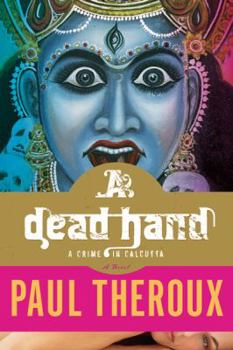
A Dead Hand: A Crime in Calcutta


Select Format
Select Condition 
Book Overview
When Jerry Delfont, an aimless travel writer with writer's block (his "dead hand"), receives a letter from an American philanthropist, Mrs. Merrill Unger, with news of a scandal involving an Indian... This description may be from another edition of this product.
Format:Hardcover
Language:English
ISBN:0547260245
ISBN13:9780547260242
Release Date:February 2010
Publisher:Houghton Mifflin Harcourt
Length:279 Pages
Weight:1.18 lbs.
Dimensions:9.3" x 1.3" x 6.3"
Related Subjects
Contemporary Fiction Literary Literature & Fiction Mystery, Thriller & Suspense Suspense ThrillersCustomer Reviews
5 ratings
CONRAD AND JAMES, WELL STIRRED, AND SERVED WITH A DOLLOP OF TANTRIC SEX
Published by Thriftbooks.com User , 15 years ago
Dead Hand: A Crime in Calcutta is Paul Theroux's twenty-ninth novel and his forty-third published book. He has long been a distinguished writer, whose forays into travel books have enriched his novel writing with exotic locales and peoples and insight into parts of our character that we might otherwise miss because we've learned to mask them so in our own daily dealings with the people around us. He's long been one of our more interesting authors, with a contrarian sense of the strangeness of this odd creature called man and a pronounced awareness of the existence of the Other, just outside the curtains shielding our cosseted and contained quotidian existence. I remember assigning one of his early books, The Family Arsenal, for a one-time course I taught on (trendy title -it was the seventies!) `The Contemporary Novel and the Consciousness of Loss.' I paired it with Conrad's The Secret Agent, a perfectly logical pairing not only because both novels were about the terrorist's mind but because Theroux is, of any of the writers writing today, the most likely heir of Conrad's mindset and preoccupations, with James's super refined style rafted onto it. (The course flopped, by the way. I never offered it again.) Hand is neither the best nor the worst of Theroux's many books. It tells the story of a failing travel writer, Jerry Delfont, who is stuck in Calcutta and struggling to overcome writer's block, his own `dead hand.' He responds to a letter, gauche and imperious, from an American woman who claims to his fan, asking for his help in clearing up a mystery: an Indian friend of her son woke up in his hotel room to find a dead boy on the carpet. He fled to avoid arrest: the crime has to be cleared up if he is to be free from arrest. Ineluctably, Delfont is drawn in by the woman, a devotee of the cruel goddess Kali and a devotee of tantric yoga and sex. Is she a good woman, as she claims and he at first believes, or is there a darker side to her actions and sayings? Delfont's comings and goings lead him across India, a subcontinent of savage contrasts and brutal indifference to suffering and injustice. The tone is set with a brief incident described on page 5, almost offhandedly: An expat couple leaves its infant child with the child's Indian amah. Walking home one afternoon in a distant neighborhood, they see their nanny panhandling in the traffic, holding an infant -their son--in her arms. The child is "drooling and dazed, ... drugged with opium." This is a twisty sort of novel, with many surprise turns en route. One of the most fascinating is when Delfont receives a request from the famous travel writer, Paul Theroux, for an interview. The result is a tour de force, and one of the sliest, most insidious self-putdowns I've come across in a lifetime of reading novels. It's almost as though, for a few pages (pages 126-137), Theroux encounters Diderot, or Sterne, or one of the other experimentalist fiction writers of the late
Where is the author in this book?
Published by Thriftbooks.com User , 16 years ago
I have read several travel books, and the novel Mosquito Coast, by Paul Theroux. I liked them all. This one is something very different. It is told from the point of view of a traveling writer who does magazine stories, and appears on American cable tv. He finds himself in India, a guest of the US government as some kind of cultural exhibit. He is very depressed because he cannot seem to get anything written. A character called "Paul Theroux" makes a brief appearance and seems to be digging for a facts about a very rich American philanthropist who everybody knows about, but nobody actually knows her. Our narrator has received a personal letter from her in the very first sentence of the book! The narrator is gradually sucked into a mystery--a dead child, dismembered. Where did the child come from? Why was the body in that room? A crime in Calcutta is the essence of this book. There is a faint awareness of unease, confusion, at the beginning of the book. That only grows. Near the middle: "In any other city it would have passed for colorful and fun; in Calcutta it seemed joyless, even menacing, the sort of place Theroux might use as a setting for his Indian fictions." By the end this is a frightening place where I would never want to visit. It is an exotic setting that grows ever more intense and awful. It all seems a crime against humanity to my provincial American morality. The wonderful American philanthropist becomes hideous. The people all part of a society too old, complex, enigmatic. When does this all take place? Mother Teresa is dead, in this novel, but the place names are obsolete. Calcutta is not on any contemporary map. I only hope the Indian society of this book is also obsolete, only the product of a traveling writer's imagination.
A Dead Hand; A Crime in Calcutta
Published by Thriftbooks.com User , 16 years ago
I picked up a copy of this novel in Calcutta at an old established book store on Park Street 2 weeks ago. Reading this after so recently returning from India was interesting. My time in Calcutta was relatively short, I did have a few days at the end of my journey to feel out this city. I was transported with ease back into Kolkata, the street names, the chaos, the traffic, the noise, the sacred, the juxtaposition of the Oberoi Grand with the street vendors on the sidewalk outside it's gates. The ghats on the Houghly River, the early morning flower market before sunrise, the street children running here and there - gesticulating hand to mouth - feed me! I couldn't put this book down, the smells, the sounds, the sights came rushing back to me. I relished this book I agree with a previous reveiwer that this is one of the of the best dissections of this subcontinent since Rohinton Mistry's "A FIne Balance". This is a wonderful examination of this perplexing country - one that is difficult if not impossible to understand. The more I visit - my 4th trip- the less I understand the complexities and I am yet drawn again to Mother India.
"Only Obey. Ask No Questions"
Published by Thriftbooks.com User , 16 years ago
In what is arguably his best novel since "The Mosquito Coast", the well-traveled wordsmith Paul Theroux knocks it out of the, um, cricket pitch in "The Dead Hand", a brooding and obsessive mystery set in Calcutta's hellishly writhing slums of human wreckage. The title refers to "writer's block", of which burnt-out travel writer-protagonist Jerry Delfont suffers. Languishing in a middling Calcutta hotel with nothing left to write, the middle-aged Delfont receives an enigmatic letter from a wealthy American ex-pat, Mrs. Merrill Unger, telling the tale of a dead boy found in her friend's room in a flea-bag Calcutta slum hotel. Against better judgment, Delfont follows the letter to its source, meeting the surprisingly sensual and alluring Mrs. Unger. Soon Delfont's globetrotting plans are on hold, and smitten by Unger's sinuous charms, he soon finds the more literal meanings to a "dead hand." Over his head in Bengalese mysticism and tantric sex, a pawn on a chess board with dimensions well beyond his comprehension, Delfont falls ever deeper under Unger's spell, learning his past travelogues have not even scratched the surface of India's impenetrable culture. Theroux spins his prose with same transcendental magic he uncovers in Hindu temples and fetid alleyways. This is the stuff that recalls The Orient Express and old black and white movies - exotic, mildly occult, and continually shadowed by an unseen but clearly palpable sense of dread. The author adds delicious depth and color with smattering vestiges of the British Empire, rich in "mountebanks" and "calumnies" and "ironmongery" and rich remnants of Victorian "sensibilities" left behind in the west, while left alone to flourish on the subcontinent. True to Theroux's own travelogue roots, the stink of traffic, the seething masses, the noise of horns and bicycle bells fill Calcutta's thickened air, while Theroux casts himself in a cleverly self-depreciating cameo role. In short, "The Dead Hand" is a blockbuster that satisfies on multiple fronts: the best western dissection of Indian culture since Rohinton Mistry's haunting "A Fine Balance." An engaging mystery that will keep you riveted to the pages, while holding in enough suspense, thrills, and startling visual images of abuse and depravity to make you want to walk away, fully realizing you are powerless to do so. Poignant, appropriately ambiguous, and frightening, "The Dead Hand" is a brilliant novel that will leave a mark on your soul that will not easily fade.
"Find a do-gooder and you'll see at bottom there's something wrong with his life."
Published by Thriftbooks.com User , 16 years ago
The ennui of a travel writer in Calcutta is the catalyst for a strange tale of obsession, betrayal and exploitation. Jerry Delfont has come to a moment of reckoning in his career as he considers his "dead hand", writer's block, admitting he has been "pretending to be a writer when I was only indulging myself as a tourist". Salvation arrives in the form of a letter from a wealthy woman, Merrill Unger, who appeals to Delfont to help her solve the mystery of a dead child, to shed light on an outrageous story told by her son's friend, Rajat. Delfont reads the letter, "amused by its presumption", but, with few demands on his time, he agrees to meet Mrs. Unger, who is far more formidable in person than he has imagined. A philanthropist who decries the sainted Mother Theresa for false humility, Mrs. Unger quietly runs an orphanage and is involved with many humanitarian works besides the business that has brought her to Calcutta. Contrary to his assumptions, Mrs. Unger is devastatingly beautiful, powerful in a way he has never encountered before in a relationship. At this precarious time in the writer's life, the attention of this woman is a balm to the soul of a man doubting his viability in the world. Slowly introduced to Mrs. Unger's environment, which includes her devotion to the goddess Kali, Delfont falls into an unexpected but welcome state, impatiently anticipating the next contretemps with the American philanthropist he has begun to view as a visionary, a saintly, complicated woman who introduces him to the ecstasy of tantric sex. Delhunt nearly forgets his mission to learn more about the dead child in the hotel room in his urgency to be near Mrs. Unger. Theroux's Calcutta teems with humanity, the deprived and the desperate, a rigid class system and the scars of poverty: "India has a market economy... there are no suitors, only customers." Mrs. Unger seems an extraordinary person to the once-cynical writer, who is daily more entranced by her exotic seduction. But, as the circumstances around the child's dead body fall into place, Delhunt's faith in human nature is challenged, India exposed in all its moral ambiguities. Theroux throws in an extra twist when his protagonist is introduced to author Paul Theroux, also seeking information on the mysterious Mrs. Unger, a curious conceit in a place where nothing is what it seems. As Mrs. Unger honors the goddess Kali, so does Delhunt worship at the altar of obsession, slow to wake from his hedonistic haze and a reality he cannot ignore. Luan Gaines/2010.
Copyright © 2026 Thriftbooks.com Terms of Use
| Privacy Policy | Do Not
Sell/Share My Personal Information | Cookie Policy | Cookie Preferences | Accessibility Statement
ThriftBooks® and the ThriftBooks® logo are registered trademarks of Thrift Books Global, LLC
ThriftBooks® and the ThriftBooks® logo are registered trademarks of Thrift Books Global, LLC
