


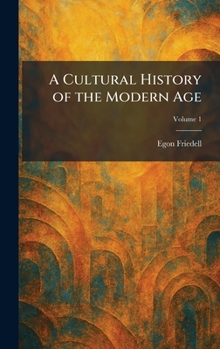
A Cultural History of the Modern Age

"A Cultural History of the Modern Age" by Egon Friedell is a monumental survey of the intellectual and spiritual life of Western civilization. In this first volume, Friedell explores the transition from the late Middle Ages to the dawn of the modern era, beginning with the cataclysmic impact of the Black Death and moving through the transformative periods of the Renaissance and the Reformation. Unlike traditional historical narratives focused solely on political events, this work delves into the "soul" of each epoch, examining the shifts in art, philosophy, religion, and daily life that define a culture.
Friedell's writing is characterized by its brilliant wit, provocative insights, and sweeping scope. He treats history not as a dry collection of facts, but as a living drama shaped by ideas and the collective psyche. By tracing the evolution of European thought and social structures, the author provides a deep understanding of the roots of modernity. This work remains a classic of cultural history, offering readers a panoramic view of the forces that have shaped the Western world.
This work has been selected by scholars as being culturally important, and is part of the knowledge base of civilization as we know it. This work was reproduced from the original artifact, and remains as true to the original work as possible. Therefore, you may see the original copyright references, library stamps (as most of these works have been housed in our most important libraries around the world), and other notations in the work.
This work is in the public domain in the United States of America, and possibly other nations. Within the United States, you may freely copy and distribute this work, as no entity (individual or corporate) has a copyright on the body of the work.
As a reproduction of a historical artifact, this work may contain missing or blurred pages, poor pictures, errant marks, etc. Scholars believe, and we concur, that this work is important enough to be preserved, reproduced, and made generally available to the public. We appreciate your support of the preservation process, and thank you for being an important part of keeping this knowledge alive and relevant.
Customer Reviews
ThriftBooks ® and the ThriftBooks ® logo are registered trademarks of Thrift Books Global, LLC
