


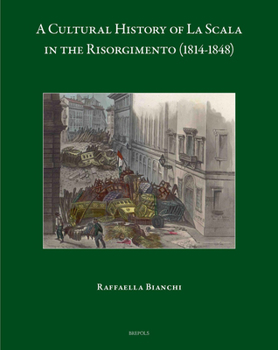
A Cultural History of La Scala in the Risorgimento (1814-1848)
No Customer Reviews

This study of the La Scala opera house uses the approaches of cultural history to explore the world of Milan's historic opera house at a crucial point in Italian History. It sheds new life on La Scala's public, its rules of attendance, management, as well as its central role in the Italian national movement (the Risorgimento). Based on unpublished archival sources, the book explores a world of secret gatherings, revolutionary conspiracies hatched in opera boxes, displays of power, the architectures of surveillance, and the symbolic and gendered politics of operatic performances; in this world even the central lamp of the opera house took on political significance. In the early nineteenth century, while Giuditta Pasta and Maria Malibran performed Norma, box curtains were used for public demonstrations, keys of lateral doors were contested between the impresario and the police, and a monumental gas lamp was built and installed assembled in order to spy on the public. The central claim of the book is that a multifaceted cultural struggle was fought at La Scala. The argument is constructed through a rigorous approach to original sources and an extensive analysis of archivalmaterial. Thanks to these sources, the book makes an important, original contribution to the study of Italian history.
Format:Hardcover
Language:English
ISBN:2503602444
ISBN13:9782503602448
Release Date:October 2022
Publisher:Brepols Publishers
Length:320 Pages
Weight:6.98 lbs.
Related Subjects
HistoryCustomer Reviews
0 rating
Copyright © 2026 Thriftbooks.com Terms of Use
| Privacy Policy | Do Not
Sell/Share My Personal Information | Cookie Policy | Cookie Preferences | Accessibility Statement
ThriftBooks® and the ThriftBooks® logo are registered trademarks of Thrift Books Global, LLC
ThriftBooks® and the ThriftBooks® logo are registered trademarks of Thrift Books Global, LLC
