


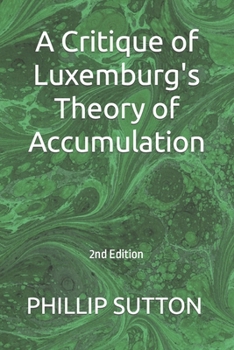
A Critique of Luxemburg's Theory of Accumulation
No Customer Reviews

Rosa Luxemburg is a important marxist theoritician who played an major part in laying the basis for a marxist understanding of capitalism's development in the 20th and 21st century. However her analysis of capitalist accumulation has had both partisan followers and detractors since it was first presented in 1913 in her book, The Accumulation of Capital. This is how Luxemburg summarised the process in Chapter 32 of her book: "Capital accumulation progresses and expands at the expense of non-capitalist strata and countries, squeezing them out at an ever faster rate. The general tendency and final result of this process is the exclusive world rule of capitalist production. Once this is reached, Marx's model becomes valid: accumulation, i.e. further expansion of capital, becomes impossible. Capitalism comes to a dead end, it cannot function any more as the historical vehicle for the unfolding of the productive forces, it reaches its objective economic limit." This pamphlet revisits what her book actually says about the process of accumulation and raises questions about Luxemburg's explanations of her theory. It investigates the key components of her theory and questions whether it can by justified in light of the continuing growth of the capitalist economy since it was first presented.
Format:Paperback
Language:English
ISBN:B095RXNZ53
ISBN13:9798733143033
Release Date:May 2021
Publisher:Independently Published
Length:110 Pages
Weight:0.35 lbs.
Dimensions:0.2" x 6.0" x 9.0"
Customer Reviews
0 rating
Copyright © 2026 Thriftbooks.com Terms of Use
| Privacy Policy | Do Not
Sell/Share My Personal Information | Cookie Policy | Cookie Preferences | Accessibility Statement
ThriftBooks® and the ThriftBooks® logo are registered trademarks of Thrift Books Global, LLC
ThriftBooks® and the ThriftBooks® logo are registered trademarks of Thrift Books Global, LLC
