


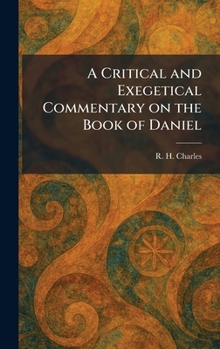
A Critical and Exegetical Commentary on the Book of Daniel

"A Critical and Exegetical Commentary on the Book of Daniel" is a cornerstone of twentieth-century biblical scholarship, providing an exhaustive analysis of one of the Old Testament's most complex and influential texts. This monumental work employs a rigorous philological and historical-critical approach to unravel the linguistic, historical, and theological layers of the Danielic visions and narratives.
The commentary delves deeply into the book's bilingual nature, examining both the Hebrew and Aramaic sections with detailed textual criticism. R. H. Charles, a preeminent expert in apocalyptic literature, contextualizes "The Book of Daniel" within the broader tradition of Jewish apocalypticism, offering crucial insights into its composition during the Maccabean period. By combining deep philological expertise with a thorough understanding of the Hellenistic world, the work explores themes of divine sovereignty, the endurance of the faithful under persecution, and the symbolic imagery of the four empires.
This volume remains an essential reference for theologians, historians, and students of the Bible, offering a profound understanding of the prophetic and apocalyptic dimensions that shaped later religious thought.
This work has been selected by scholars as being culturally important, and is part of the knowledge base of civilization as we know it. This work was reproduced from the original artifact, and remains as true to the original work as possible. Therefore, you may see the original copyright references, library stamps (as most of these works have been housed in our most important libraries around the world), and other notations in the work.
This work is in the public domain in the United States of America, and possibly other nations. Within the United States, you may freely copy and distribute this work, as no entity (individual or corporate) has a copyright on the body of the work.
As a reproduction of a historical artifact, this work may contain missing or blurred pages, poor pictures, errant marks, etc. Scholars believe, and we concur, that this work is important enough to be preserved, reproduced, and made generally available to the public. We appreciate your support of the preservation process, and thank you for being an important part of keeping this knowledge alive and relevant.
Customer Reviews
ThriftBooks ® and the ThriftBooks ® logo are registered trademarks of Thrift Books Global, LLC
