


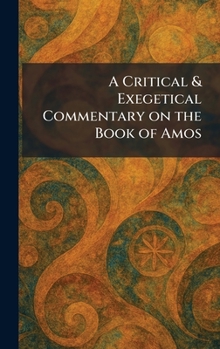
A Critical & Exegetical Commentary on the Book of Amos

"A Critical & Exegetical Commentary on the Book of Amos" provides a rigorous and scholarly examination of one of the most significant prophetic voices in the Old Testament. This work delves into the historical, linguistic, and theological complexities of the text, offering a comprehensive analysis of the message of Amos within its ancient eighth-century BCE context.
The commentary focuses on the central themes of the "Book of Amos", including social justice, divine sovereignty, and the ethical demands of the covenant. By employing detailed exegetical methods, the work clarifies the structure of the prophetic oracles and addresses difficult textual passages to provide a clearer understanding of the original Hebrew meaning. This study is particularly valuable for its focus on the socio-political climate of Israel during the prophet's ministry, explaining how his calls for righteousness and warnings of judgment resonated in his time.
Suitable for scholars, theologians, and students of biblical literature, this work serves as an essential guide to the literary and moral depth of the minor prophets. Its systematic approach ensures that the theological impact of Amos's message remains accessible, highlighting the enduring relevance of his critiques of power and his vision for a just society.
This work has been selected by scholars as being culturally important, and is part of the knowledge base of civilization as we know it. This work was reproduced from the original artifact, and remains as true to the original work as possible. Therefore, you may see the original copyright references, library stamps (as most of these works have been housed in our most important libraries around the world), and other notations in the work.
This work is in the public domain in the United States of America, and possibly other nations. Within the United States, you may freely copy and distribute this work, as no entity (individual or corporate) has a copyright on the body of the work.
As a reproduction of a historical artifact, this work may contain missing or blurred pages, poor pictures, errant marks, etc. Scholars believe, and we concur, that this work is important enough to be preserved, reproduced, and made generally available to the public. We appreciate your support of the preservation process, and thank you for being an important part of keeping this knowledge alive and relevant.
Customer Reviews
ThriftBooks ® and the ThriftBooks ® logo are registered trademarks of Thrift Books Global, LLC
