


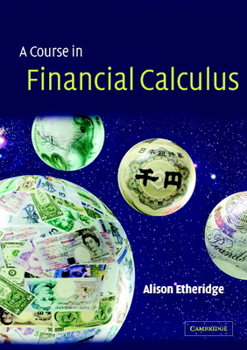
A Course in Financial Calculus


Select Format
Select Condition 
Book Overview
Finance provides a dramatic example of the successful application of advanced mathematical techniques to the practical problem of pricing financial derivatives. This self-contained 2002 text is designed for first courses in financial calculus aimed at students with a good background in mathematics. Key concepts such as martingales and change of measure are introduced in the discrete time framework, allowing an accessible account of Brownian motion and stochastic calculus: proofs in the continuous-time world follow naturally. The Black-Scholes pricing formula is first derived in the simplest financial context. The second half of the book is then devoted to increasing the financial sophistication of the models and instruments. The final chapter introduces more advanced topics including stock price models with jumps, and stochastic volatility. A valuable feature is the large number of exercises and examples, designed to test technique and illustrate how the methods and concepts can be applied to realistic financial questions.
Format:Paperback
Language:English
ISBN:0521890772
ISBN13:9780521890779
Release Date:September 2002
Publisher:Cambridge University Press
Length:206 Pages
Weight:0.94 lbs.
Dimensions:0.4" x 6.9" x 9.8"
Customer Reviews
1 rating
A fascinating look at making randomness differentiable
Published by Thriftbooks.com User , 22 years ago
The behavior of large economic systems is by necessity unpredictable, for if it was, then the making of speculative profit would be impossible. The movement of markets is modeled as an example of Brownian motion, which is a consequence of the random motion of molecules. This is a complex process, where the only hope to predict the future is to apply statistical methods. Therefore, this book is largely a lesson in creating statistical models of random processes that allow for calculus methods to be used to analyze them. The primary model is that of a discrete parameter martingale, which is where different price possibilities are computed based on probabilities that the parameter will have certain values. After years of teaching calculus, this is the first book that I have read where the concentration is on using calculus to model financial systems. Without question, I learned more new material from this book than I have in at least 90% of the math books that I have read. It was fascinating to see how a non-differentiable system is modeled so that it is then possible to use the continuous methods of calculus in working with it. This book is perfect for advanced courses in the modeling of financial markets. The amount of calculus knowledge needed to understand the material is that of the standard three course sequence that is the start of nearly all undergraduate majors. A course in statistics based on calculus is also essential, and experience in differential equations would also be helpful, although not required. The only reason that it does not get a fifth star is that there are no solutions to the exercises. I am a firm believer that solutions to at least 1/3 the problems should be included in any mathematics book.Published in the recreational mathematics e-mail newsletter, reprinted with permission.
Copyright © 2026 Thriftbooks.com Terms of Use
| Privacy Policy | Do Not
Sell/Share My Personal Information | Cookie Policy | Cookie Preferences | Accessibility Statement
ThriftBooks® and the ThriftBooks® logo are registered trademarks of Thrift Books Global, LLC
ThriftBooks® and the ThriftBooks® logo are registered trademarks of Thrift Books Global, LLC
