


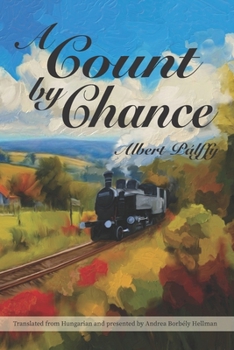
A Count by Chance
No Customer Reviews

A Count by Chance (Egy m rn k reg nye, 1885) is a late 19th-century Hungarian novel that offers both an immersive glimpse into aristocratic life and a deeper undercurrent of intrigue, jealousy, and betrayal. At first glance, the novel appears to be an elegant portrait of an era-landowners riding horses and carriages through the Hungarian countryside, well-born ladies exchanging witty gossip in mirrored drawing rooms, and gentlemen bowing as they enter grand parlors. The newly constructed railway and telephone wires weaving through the vast landscape suggest the rapid modernization of the time. The novel's charm lies in this vivid depiction of Victorian-era Eastern European nobility, their luxurious travels, and their social rituals. Yet, beneath the polished veneer of silk dresses, palace intrigue, and refined etiquette, a much darker story unfolds-one of betrayal, greed, prejudice, and a rigid class system that denies people their rightful place in society. At its heart, the novel revolves around the betrayal of a young revolutionary soldier, his soulful newlywed wife, and their infant son, whose identity and rights are stripped away due to the jealousy of a powerful noblewoman. Their tragic fate would have remained hidden were it not for the incessant parlor gossip that thrives in this small, interconnected world. Why This Translation Matters
This is the first known English translation of "A Count by Chance" (originally titled "The Engineer's Novel" in Hungarian), offering modern readers an authentic glimpse into 19th-century Hungarian society-a world that was both enchanted and insidious. The new title better reflects the novel's central theme of birthright and the capricious nature of fortune in determining one's station in life. The novel provides an immersive experience into a bygone era, allowing readers to revel in aristocratic customs, breathtaking countryside settings, and the opulence of Budapest's grand salons. At the same time, it exposes the inner workings of a world bound by secrecy, ambition, and power struggles.
For English readers who enjoy Victorian fiction, "A Count by Chance" serves as an Eastern European counterpart-offering all the elegance and refinement of British drawing-room dramas while presenting a uniquely Hungarian perspective on class, inheritance, and political change. By making this novel accessible in English for the first time, the translation invites readers to appreciate both its entertainment value and its social critique. Albert P lffy (1820-1897) was a Hungarian writer, journalist, and intellectual who played a role in 19th-century literary and political movements. Initially trained as a lawyer, he never practiced and instead pursued literature, befriending revolutionary poet S ndor Petőfi and aligning himself with the Hungarian Romantic movement. He opposed censorship and advocated for press freedom, working as a journalist and editor. His support for the Hungarian Revolution of 1848 led to his imprisonment and eventual exile. Later in life, he wrote novels, often producing one a year, focusing on light romances and social critiques. "A Count by Chance," written at the height of his novel-writing years, stands out for its layered storytelling, balancing elegance with cynicism, beauty with hidden corruption. "A Count by Chance" is both a captivating immersion into 19th-century Hungarian aristocracy and a sharp-eyed critique of the power struggles beneath the surface. Its ability to charm and unsettle at the same time makes it a compelling read. This translation allows modern readers to enjoy its elegance while recognizing its deeper layers of deception, ambition, and betrayal. As a novel that both seduces and exposes, it offers a uniquely rich reading experience.
This is the first known English translation of "A Count by Chance" (originally titled "The Engineer's Novel" in Hungarian), offering modern readers an authentic glimpse into 19th-century Hungarian society-a world that was both enchanted and insidious. The new title better reflects the novel's central theme of birthright and the capricious nature of fortune in determining one's station in life. The novel provides an immersive experience into a bygone era, allowing readers to revel in aristocratic customs, breathtaking countryside settings, and the opulence of Budapest's grand salons. At the same time, it exposes the inner workings of a world bound by secrecy, ambition, and power struggles.
For English readers who enjoy Victorian fiction, "A Count by Chance" serves as an Eastern European counterpart-offering all the elegance and refinement of British drawing-room dramas while presenting a uniquely Hungarian perspective on class, inheritance, and political change. By making this novel accessible in English for the first time, the translation invites readers to appreciate both its entertainment value and its social critique. Albert P lffy (1820-1897) was a Hungarian writer, journalist, and intellectual who played a role in 19th-century literary and political movements. Initially trained as a lawyer, he never practiced and instead pursued literature, befriending revolutionary poet S ndor Petőfi and aligning himself with the Hungarian Romantic movement. He opposed censorship and advocated for press freedom, working as a journalist and editor. His support for the Hungarian Revolution of 1848 led to his imprisonment and eventual exile. Later in life, he wrote novels, often producing one a year, focusing on light romances and social critiques. "A Count by Chance," written at the height of his novel-writing years, stands out for its layered storytelling, balancing elegance with cynicism, beauty with hidden corruption. "A Count by Chance" is both a captivating immersion into 19th-century Hungarian aristocracy and a sharp-eyed critique of the power struggles beneath the surface. Its ability to charm and unsettle at the same time makes it a compelling read. This translation allows modern readers to enjoy its elegance while recognizing its deeper layers of deception, ambition, and betrayal. As a novel that both seduces and exposes, it offers a uniquely rich reading experience.
Format:Paperback
Language:English
ISBN:B0F13BBV1Y
ISBN13:9798313541051
Release Date:March 2025
Publisher:Independently Published
Length:448 Pages
Weight:1.31 lbs.
Dimensions:0.9" x 6.0" x 9.0"
Customer Reviews
0 rating
Copyright © 2025 Thriftbooks.com
Terms of Use | Privacy Policy | Do Not Sell/Share My Personal Information | Cookie Policy | Cookie Preferences | Accessibility Statement
ThriftBooks ® and the ThriftBooks ® logo are registered trademarks of Thrift Books Global, LLC
ThriftBooks ® and the ThriftBooks ® logo are registered trademarks of Thrift Books Global, LLC
