


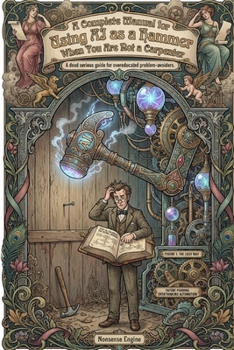
A Complete Manual for Using AI as a Hammer When You Are Not a Carpenter: A dead serious guide for overeducated problem-avoiders.

You have a hammer. You have AI. You have a nail. So why are you writing a 500-word prompt?
This is not a self-help book. This is a manual-forensic, unsparing, and written in the tone of a deposition-that examines what happens when we deploy our most sophisticated tools to solve our simplest problems. It is an investigation into why we do this, what it costs us, and what it reveals about the way we work.
The premise is straightforward: large language models are extraordinary at reasoning through complexity, synthesizing information, and navigating ambiguity. A nail driven into wood requires none of these things. Yet millions of knowledge workers now reach for AI before reaching for basic competence, basic training, or basic judgment. This manual explores that choice without irony or mercy. It asks why we prefer the appearance of rigor to the reality of skill. It asks what we lose when we mediate every decision through an algorithm. It asks whether the problem was ever the tool, or whether the tool was always the excuse.
Inside you will find:
- A framework for distinguishing carpenter-level problems from actually complex ones-and why this distinction has become professionally taboo
- Case studies of three organizations that used AI to avoid training their staff-and the long-term cost of that choice
- An anatomy of the prompt as a substitute for judgment-and how to recognize when you are writing one
- Practical guidance on when to actually use the hammer-and how to rebuild competence in a workplace designed to outsource it
- The hidden architecture of modern knowledge work-and how complexity became a liability instead of an asset
This manual treats every absurd premise with the gravity of a courtroom transcript. It is written for the overeducated, the risk-averse, and the professionally competent who have begun to suspect that they are using their tools not to solve problems, but to avoid them. It is written for anyone who has noticed that the more sophisticated our technology becomes, the less willing we seem to be to do anything ourselves.
The human truth at the center of this book is simple: we use complexity to evade accountability and obscure our own incompetence. This manual is an invitation to stop.
From the absurd-but-earnest imprint Nonsense Engine.
Customer Reviews
ThriftBooks ® and the ThriftBooks ® logo are registered trademarks of Thrift Books Global, LLC
