


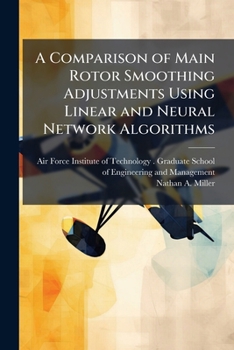
A Comparison of Main Rotor Smoothing Adjustments Using Linear and Neural Network Algorithms

Helicopter main rotor smoothing is a maintenance procedure that is routinely performed to minimize destructive airframe vibrations induced by non-uniform mass and/or aerodynamic distributions in the main rotor system. This important task is both time consuming and expensive, so improvements to the process have been long sought. Traditionally, vibrations have been minimized by calculating adjustments based on an assumed linear relationship between adjustments and vibration response. In recent years, artificial neural networks have been designed to recognize non-linear mappings between adjustments and vibration response. This research was conducted in order observe the mathematical character of the adjustment mapping of the Vibration Management Enhancement Program's PC-Ground Base System (PC-GBS). Flight data from the UH- 60, AH-64A, and AH-64D were utilized during the course of this study. What has been determined is that, in a majority of situations, the neural networks of the PC-GBS produce adjustments that can be reproduced by a linear algorithm, thus implying that the character of the mapping is in fact linear.
This work has been selected by scholars as being culturally important, and is part of the knowledge base of civilization as we know it. This work was reproduced from the original artifact, and remains as true to the original work as possible. Therefore, you will see the original copyright references, library stamps (as most of these works have been housed in our most important libraries around the world), and other notations in the work.
This work is in the public domain in the United States of America, and possibly other nations. Within the United States, you may freely copy and distribute this work, as no entity (individual or corporate) has a copyright on the body of the work.
As a reproduction of a historical artifact, this work may contain missing or blurred pages, poor pictures, errant marks, etc. Scholars believe, and we concur, that this work is important enough to be preserved, reproduced, and made generally available to the public. We appreciate your support of the preservation process, and thank you for being an important part of keeping this knowledge alive and relevant.
Customer Reviews
ThriftBooks® and the ThriftBooks® logo are registered trademarks of Thrift Books Global, LLC
