


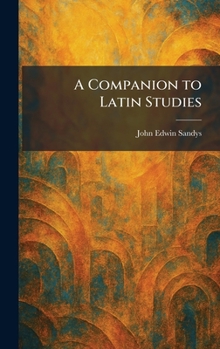
A Companion to Latin Studies

Select Format
Select Condition 
Book Overview
"A Companion to Latin Studies" is an exhaustive and authoritative reference work designed to provide a comprehensive overview of the Roman world. Compiled under the expert editorship of Sir John Edwin Sandys, this monumental volume serves as an essential guide for students and scholars of classical antiquity. The work spans a vast array of subjects, including Roman geography, ethnology, and flora, as well as detailed explorations of Roman history, religion, and law.
Readers will find in-depth sections dedicated to the development of the Latin language and its literature, alongside examinations of Roman social life, commerce, and military organization. The text also delves into specialized areas such as epigraphy, paleography, and numismatics, offering a holistic view of the civilization that shaped Western thought. By synthesizing the contributions of numerous experts, "A Companion to Latin Studies" provides a structured and detailed account of the political, intellectual, and cultural achievements of Rome. Its meticulous approach makes it an invaluable resource for anyone seeking to understand the complexities of the classical past and the foundations of Latin scholarship.
This work has been selected by scholars as being culturally important, and is part of the knowledge base of civilization as we know it. This work was reproduced from the original artifact, and remains as true to the original work as possible. Therefore, you may see the original copyright references, library stamps (as most of these works have been housed in our most important libraries around the world), and other notations in the work.
This work is in the public domain in the United States of America, and possibly other nations. Within the United States, you may freely copy and distribute this work, as no entity (individual or corporate) has a copyright on the body of the work.
As a reproduction of a historical artifact, this work may contain missing or blurred pages, poor pictures, errant marks, etc. Scholars believe, and we concur, that this work is important enough to be preserved, reproduced, and made generally available to the public. We appreciate your support of the preservation process, and thank you for being an important part of keeping this knowledge alive and relevant.
Customer Reviews
ThriftBooks ® and the ThriftBooks ® logo are registered trademarks of Thrift Books Global, LLC
