


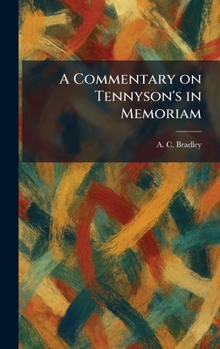
A Commentary on Tennyson's in Memoriam

"A Commentary on Tennyson's In Memoriam" is an essential scholarly guide to one of the most profound and influential poems of the Victorian era. Written by the esteemed literary critic A. C. Bradley, this work provides a comprehensive section-by-section analysis of Alfred Lord Tennyson's celebrated elegy. The poem itself, "In Memoriam A.H.H.," is a monumental exploration of grief, faith, and the struggle between science and religion, written in the wake of the sudden loss of Tennyson's close friend Arthur Henry Hallam.
Bradley's commentary serves as an invaluable companion for readers seeking to navigate the complex structure and evolving philosophical themes of the original text. He meticulously traces the progression of the poet's emotional journey from overwhelming despair and doubt to a hard-won sense of hope and spiritual reconciliation. Through insightful interpretations of the poem's imagery, meter, and historical context, Bradley illuminates the artistic mastery behind Tennyson's verses.
This volume is highly regarded for its clarity and depth, making it a vital resource for students of English literature, Victorian history, and the art of the elegy. It remains a cornerstone of Tennysonian scholarship, offering a bridge between the reader and the intricate lyrical architecture of the 19th century's greatest tribute to friendship and mortality.
This work has been selected by scholars as being culturally important, and is part of the knowledge base of civilization as we know it. This work was reproduced from the original artifact, and remains as true to the original work as possible. Therefore, you may see the original copyright references, library stamps (as most of these works have been housed in our most important libraries around the world), and other notations in the work.
This work is in the public domain in the United States of America, and possibly other nations. Within the United States, you may freely copy and distribute this work, as no entity (individual or corporate) has a copyright on the body of the work.
As a reproduction of a historical artifact, this work may contain missing or blurred pages, poor pictures, errant marks, etc. Scholars believe, and we concur, that this work is important enough to be preserved, reproduced, and made generally available to the public. We appreciate your support of the preservation process, and thank you for being an important part of keeping this knowledge alive and relevant.
Customer Reviews
ThriftBooks ® and the ThriftBooks ® logo are registered trademarks of Thrift Books Global, LLC
