


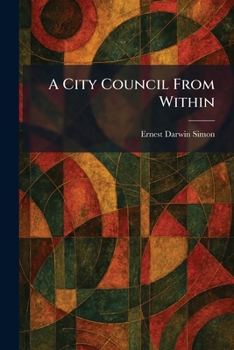
A City Council From Within

Select Format
Select Condition 
Book Overview
"A City Council From Within" is an insightful and authoritative analysis of British municipal government during the interwar period. Written by Ernest Darwin Simon, a former Lord Mayor of Manchester and a dedicated social reformer, the work offers a rare insider perspective on the operations, challenges, and responsibilities of local authorities. The text provides a comprehensive look at how city councils manage diverse portfolios, including public health, housing, education, and infrastructure, emphasizing the growing complexity of urban administration in the early 20th century.
Simon explores the relationship between elected councillors and permanent officials, the efficacy of the committee system, and the financial pressures inherent in local governance. By detailing the day-to-day realities of civic management, the work advocates for greater efficiency and a more professional approach to public service. "A City Council From Within" serves as both a practical guide for those involved in local politics and a significant historical study of the evolution of the modern city. It remains a vital resource for understanding the foundations of local democracy and the pivotal role of municipal leadership in improving the quality of urban life.
This work has been selected by scholars as being culturally important, and is part of the knowledge base of civilization as we know it. This work was reproduced from the original artifact, and remains as true to the original work as possible. Therefore, you may see the original copyright references, library stamps (as most of these works have been housed in our most important libraries around the world), and other notations in the work.
This work is in the public domain in the United States of America, and possibly other nations. Within the United States, you may freely copy and distribute this work, as no entity (individual or corporate) has a copyright on the body of the work.
As a reproduction of a historical artifact, this work may contain missing or blurred pages, poor pictures, errant marks, etc. Scholars believe, and we concur, that this work is important enough to be preserved, reproduced, and made generally available to the public. We appreciate your support of the preservation process, and thank you for being an important part of keeping this knowledge alive and relevant.
Customer Reviews
ThriftBooks ® and the ThriftBooks ® logo are registered trademarks of Thrift Books Global, LLC
