


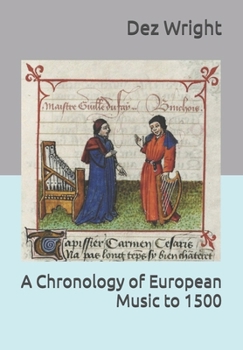
A Chronology of European Music to 1500
No Customer Reviews

What is most fascinating about the period up to 1500 is that it is the era that Western Classical music underwent the majority of its development. Many would argue that composing for the voice reached a peak during the fifteenth century that it has never surpassed. The great orchestras may not have existed, but the techniques of writing polyphonic music for voices are not altogether different to scoring music for instruments. There is a dominance of the Christian church through these pages. This is inevitable for a number of reasons. Throughout this period, from Christianity's adoption as the official religion of the Roman Empire, the church was all-pervasive in life. It was dominant in a way that is not easy to comprehend today, certainly not in secular Europe. Literacy and learning were not widespread. If you wanted an education, even if you were wealthy, or of noble blood, then inevitably it was a church or monastery education that you got. Most surviving writings on any topic are by monks, nuns, priests, and other religious figures. The survival rate of church music is far higher than that of secular music. For a start, little of the latter was ever written down. Indeed, it took the Victorian and Edwardian folk song collectors to save much of the vernacular music as oral tradition became the victim of the huge changes of society during the nineteenth and twentieth centuries. Prior to the Troubadours and Trouv res of the twelfth century and beyond very little secular music has survived. The sheer volume of church music required for the number of services than ran into four figures every year in each religious institution meant that, even with a very low survival rate, much is still extant. This book is a strictly chronological look at the people and events that contributed to music's development from the time of Christ until 1500 and the eve of the Reformation. It covers an era where many lives are glimpsed through the occasional reference in a pay book here, a cryptic mention in a letter there, and a vague church record somewhere else. From these snippets it is sometimes possible to create a very broad brush biography, but even with the best documented musicians of the era there are gaps where only conjecture can add any kind of filling.
Format:Paperback
Language:English
ISBN:B0DYV91BJG
ISBN13:9798312405316
Release Date:February 2025
Publisher:Independently Published
Length:342 Pages
Weight:1.20 lbs.
Dimensions:0.7" x 6.7" x 9.6"
Customer Reviews
0 rating
Copyright © 2025 Thriftbooks.com
Terms of Use | Privacy Policy | Do Not Sell/Share My Personal Information | Cookie Policy | Cookie Preferences | Accessibility Statement
ThriftBooks ® and the ThriftBooks ® logo are registered trademarks of Thrift Books Global, LLC
ThriftBooks ® and the ThriftBooks ® logo are registered trademarks of Thrift Books Global, LLC
