


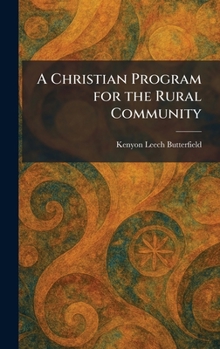
A Christian Program for the Rural Community

"A Christian Program for the Rural Community" is a comprehensive exploration of the role of the church and Christian leadership in revitalizing rural society. Authored by Kenyon L. Butterfield, a pioneer in rural sociology and a key figure in the Country Life movement, this work argues for a coordinated and visionary approach to the development of rural life in the early 20th century. It addresses the unique challenges faced by farming communities and proposes a framework where the church acts as a central hub for social, economic, and moral progress.
The text examines the interconnectedness of agriculture, education, and spiritual health, advocating for a "new rural civilization" that balances modern advancement with traditional values. It serves as a significant historical document of the Social Gospel movement, reflecting efforts to apply religious principles to complex social and economic problems. Providing valuable insights for students of religious history, sociology, and community development, "A Christian Program for the Rural Community" remains a thoughtful analysis of the social ethics required to sustain healthy and vibrant rural populations.
This work has been selected by scholars as being culturally important, and is part of the knowledge base of civilization as we know it. This work was reproduced from the original artifact, and remains as true to the original work as possible. Therefore, you may see the original copyright references, library stamps (as most of these works have been housed in our most important libraries around the world), and other notations in the work.
This work is in the public domain in the United States of America, and possibly other nations. Within the United States, you may freely copy and distribute this work, as no entity (individual or corporate) has a copyright on the body of the work.
As a reproduction of a historical artifact, this work may contain missing or blurred pages, poor pictures, errant marks, etc. Scholars believe, and we concur, that this work is important enough to be preserved, reproduced, and made generally available to the public. We appreciate your support of the preservation process, and thank you for being an important part of keeping this knowledge alive and relevant.
Customer Reviews
ThriftBooks ® and the ThriftBooks ® logo are registered trademarks of Thrift Books Global, LLC
