


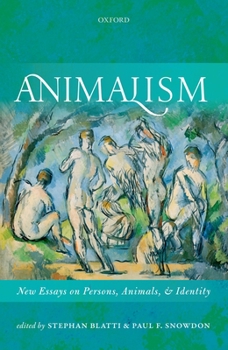
Animalism: New Essays on Persons, Animals, and Identity

Select Format
Select Condition 
Book Overview
What are we? What is the nature of the human person? Animalism has a straightforward answer to these long-standing philosophical questions: we are animals. After being ignored for a long time in philosophical discussions of our nature, this idea has recently gained considerable support in metaphysics and philosophy of mind. It has also, amongst philosophers, occasioned strong opposition, even though it might be said to be the view assumed by much of the scientific community. Essays on Animalism is the first volume to be devoted to this important topic and promises to set the agenda for the next stage in the debate. Containing mainly new papers as well as two highly important articles that were recently published elsewhere, this volume's contributors include both emerging voices in the debate and many of those who have been instrumental in shaping it. Some of their contributions defend animalism, others criticize it, still others explore its more general implications. The book also contains a substantial introduction by the editors explaining what animalism is, identifying leading issues that merit attention, and highlighting many of the issues that the contributors have raised.
Format:Hardcover
Language:English
ISBN:019960875X
ISBN13:9780199608751
Release Date:September 2016
Publisher:Oxford University Press, Incorporated
Length:344 Pages
Weight:1.25 lbs.
Dimensions:0.9" x 6.1" x 9.3"
Customer Reviews
4 ratings
Profoundly moving
Published by Thriftbooks.com User , 17 years ago
I first read this tale over 50 years ago and have remembered it ever since. Unfortunately, the author Arthur Morrison never quite caught on and the novel never received the recognition it merited. Which is a huge pity. Because having re-read it recently, I can confirm that my lasting affection for the story was not misplaced. It is basically a compelling account of the hardship and misery of life in a victorian London slum. But it is also a beautiful and persuasively written childhood adventure that deserves to be considered a minor classic of the "mean streets" genre. The story follows the lives of a family living in "the Old Jago" a psuedonym for the real slum, the Old Nichol. It graphically depicts their struggles, setbacks and adjustments through the adventures of the son and lovable scamp Dicky Perrot as he makes his way through life. The book's central proposition is that we are all creatures of our envoironments and can scarce escape it's overwhelming and pervasive influence upon our character. Considered an unduly frank and pessimistic account at the time, it contrasts interestingly with the more popular novels of Charles Dickens who described similar social settings but much less convincingly, in his tales of the period. The reader of "the Jago" is invited to compare it with "Oliver Twist" for example. I believe Morrison's work to be the better of the two and would welcome others thoughts on the subject. In essence, I recommend this work most highly. Morrison brings his consderable journalistic skills to bear in presenting his story and will leave the reader profoundly moved by the experience.
Not your average 'holiday' read
Published by Thriftbooks.com User , 18 years ago
A strongly written book comveying well it's subject matter in a well-rounded though not light-hearted way
Harshly Realistic
Published by Thriftbooks.com User , 23 years ago
Arthur Morrison's novel provides an excellent (if harsh) counterpoint to the relative gentility of Great Expectations or Wuthering Heights. You may be thinking, "Dickens and Bronte didn't pull punches," but read A Child of the Jago, and suddenly Pip's life will seem downright bucolic.Morrison gives the reader a window into the seamy underbelly of Victorian London, and exposes unimaginable living conditions and inhuman treatment. This book is a must-read if you enjoy Victorian literature. It brings to life a part of London that must be experienced to be believed.
A Dickensian style novel said with much fewer words
Published by Thriftbooks.com User , 27 years ago
The Jago was one of, if not the worst slums in London. Dicky Perrot is the main character of the story and we follow him form age 8 to about 17. His fight for survival and the responsibility he feels for his mother and sister whilst his Father is in prison makes you feel like crying. He has nothing and knows, as the local eccentric put it, that the Jago had got him and that there are only two ways out for him - to become a "Swellmobsmen" ( successful thief ) or death. Dicky is encouraged by the local Parson, Father Sturt, who is tireless in his work with the people of the Jago, to try to make something decent and honest with his life and enjoy all the things that the people who he robs enjoy and manages to secure him a job as a delivery boy for the local chandler. Unfortunately for Dicky he is dismissed thanks to an old friend who does not want him to take the straight and narrow path. After this Dicky goes down hill fast, he loses patience with his mother who takes to the Gin and leaves Em his sister to crawl in the gutter and fend for herself, his Father, disenchanted with life after coming out of prison, does his one last fatal job and at the end we see a small, poor desperate Dicky and like his old friend Beveridge told him years before, there are only two ways out of the Jago... Find out which way Dicky gets out in this excellent and realistic portrayal of life in a London slum at the turn of the century.
Copyright © 2026 Thriftbooks.com
Terms of Use | Privacy Policy | Do Not Sell/Share My Personal Information | Cookie Notice | Cookie Preferences | Accessibility Statement
ThriftBooks ® and the ThriftBooks ® logo are registered trademarks of Thrift Books Global, LLC
ThriftBooks ® and the ThriftBooks ® logo are registered trademarks of Thrift Books Global, LLC
