


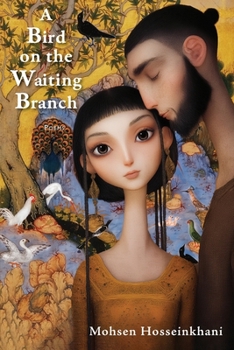
A Bird on the Waiting Branch

Love poetry written with the toolbox of necessity that touches grief and war and loss, it may remind one at times of Neruda's youthful "Twenty-One Love Poems and a Song of Despair."
Hosseinkhani's A Bird on the Waiting Branch is a book of thresholds, between lovers and distances, tenderness and terror, the private ache of longing and the public wound of war. In Tahere Forsat Safaei's clear-eyed translation, these poems move with a grave music, their melancholy sharpened into images you won't easily shake: a dried river under a bridge, a child with a snapped balloon string, an angel whose wings are glass. Threaded through this longing is a stark meditation on mortality.At the book's heart is the address to a missing "you," a second person that magnetizes the speaker's world. Hosseinkhani is at his most luminous when love is treated not as ornament but as physics: "a strong magnet" that can find the needle in a haystack; "the promise of God to Noah" against the flood of time. The distance is so absolute that the book risks myth, "Wherever you have gone / Is the farthest place of the world" yet the feeling lands because the metaphors keep rooting themselves in the tactile. The mouth that cannot say a name feels as useless as a bridge without water beneath it; the body becomes a field of practical objects failing at their purposes.
Readers drawn to lyric meditation, to poetry that fuses the domestic with the geopolitical, will find a fierce companion here. It shows how love and fear, grief and endurance, are not opposites but neighbors. Open it for the images; stay for the moral steadiness; return for the lines that echo long after the page is closed.Related Subjects
PoetryCustomer Reviews
ThriftBooks ® and the ThriftBooks ® logo are registered trademarks of Thrift Books Global, LLC
