


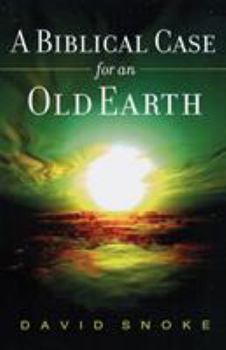
A Biblical Case for an Old Earth


Select Format
Select Condition 
Book Overview
The present creation-evolution debate is often cast as a choice between two positions: naturalistic evolution over millions of years or miraculous creation six thousand years ago. When simplified, this choice is often presented as one between science and the Bible, a choice that leaves much ground between the two views yet to be discussed.A Biblical Case for an Old Earth seeks to address the gap between theistic evolutionism and young-earth creationism by finally paying due attention to the biblical aspect of the debate. Both a scientist and a preacher, David Snoke presents a theological study of several themes in the evolution discussion, including the balance theme of Scripture and the day-age interpretation. Complete with an appendix that gives a literal translation of Genesis 1-11, this intriguing study will interest both scientists and lay Christians who want to dig into the faith-science intersection.
Format:Paperback
Language:English
ISBN:B006TR2LFA
ISBN13:9780801066191
Release Date:August 2006
Publisher:Baker Books
Length:224 Pages
Weight:0.69 lbs.
Dimensions:0.6" x 5.5" x 8.5"
Customer Reviews
5 ratings
ORDERED MORE GREAT !!!!!!!!!!!!!!!!!!!!!
Published by Thriftbooks.com User , 16 years ago
Im a commited conservative Christian and this is one of the best books i have ever read, I have just ordered another copy to loan to Christian friends who presently dont hold to his views. I loaned one to my friend who is an Scientist and he liked it so much he read it in one sitting. Mr Snoke is very smart but writes with simplicity and without bagging those who hold aguments he refutes well. I like him he is humble and very smart in a kindhearted way. In one part of the book he made me feel as if i had witnessed the very first sunrise, i will never forget it, I love him for that, Im sad he doesnt seem to have written anymore books. This book has altered my world view, it simply is GREAT.
Old Earth/Young Earth Debate - A Scientific and Biblical Case for an Ancient Creation
Published by Thriftbooks.com User , 16 years ago
One controversial topic among Christian believers is that of creation theology, especially concerning the age of God's creation. Is the earth only about 6,000 years old as most "young-earthers" insist the Bible states (seven literal 24 hour days occuring 6,000 years ago according to the geneologies in Genesis)? Or, is the earth much older, perhaps billions of years old, with the universe even older? Dr. David W. Snoke PhD, the author of this somewhat scholarly book, is a Physics professor at the University of Pittsburgh. He presents many scientific (data) proofs to show conclusively that the earth is ancient, and insists that the Bible supports the notion of an ancient earth. Snoke writes that "young-earthers" impose their particular young-earth creation theology upon the Genesis account (insisting on a literal 7-day, 24 hour creation period)- an effort that Snoke claims does not fit the text. If you have interest in this subject, this book will hold your interest from start to finish. Caution - it is not a book to casually read in one's spare time! Rather, this is a book to study, to work through slowly, much like a textbook. The scientific proofs of an ancient earth are explained in detail, and it takes time to "digest" these proofs, to learn them and understand them. After Dr. Snoke presents the scientific case for an ancient earth, he then gives a three chapter treatise on the Biblical case for an ancient earth (citing Biblical texts that support the notion that the earth is indeed ancient). He wraps up the book with the obvious (and not so obvious) implications of his evidence. (I won't list the implications here, as these would be considered "spoilers"). I consider this book an important text in the on-going debate between young and old earther Christian believers. As a student of the sciences myself, I never accepted the notion of a "young" earth, a literal 24-hour, 7-day creation week. I don't beleive Genesis should be interpreted that way, as it does not make sense scientifically, and since the Creator created both the earth and science, the two must be in harmony. As an aside, I am most grateful for the writings of Dr. Hugh Ross, Christian believer, Physicist and Astronomer. Dr. Ross's many books present the case for a "Day-Age" interpretation of Genesis, which has allowed me to understand Genesis 1 and 2 for the first time (without compromising my scientific background). (Some Hugh Ross books I highly recommend are Genesis One: A Scientific Perspective, Why the Universe Is the Way It Is, and The Genesis Question: Scientific Advances and the Accuracy of Genesis. Science and the Bible are not contradicatory (but sometimes our flawed interpretations of the scriptures are contradicatory). The God that created our world also created all the scientific principles of physics, biology, chemistry, and geology, that definitively prove we live in an ancient earth, and a much more ancient universe. Dr. Snokes' book i
The Best I've Found On This Subject
Published by Thriftbooks.com User , 16 years ago
The first few chapters of David Snoke's book should be read by everyone interested in decerning truth from error. His approach is not limited to creation theology, but instead warn us how our old assumptions can later embarrass us. His discussion of how the telescope challenged our "theology" of the movement of the earth was very helpful. I particularly liked Snoke's discussion of "can you live with it"...that is, can you consistently live by your approach and assumptions. Snoke makes the point that if you are "consistent" with always demanding the most obvious reading of a text to be "bibilical", then you must be willing to apply this approach consistently to all areas of Bible study. Snoke gives examples of this type of "obvious" reading in his examples of the movement of the earth and the return of Christ. If I was to apply additional examples, I could note the Genesis 1 Bible verse that says that God placed the sun in the sky. An obvious reading would affirm that the sun is located in the sky, which the Bible states has water above and below it. But is this "obvious" reading preferrable to the "possible" reading that God placed the "light of the sun" in the sky for signs and seasons, not the literal object of the sun in the sky? David Snoke has done a very good job of clarifying the ideas of "obvious" verses "possible" readings of scripture.
Useful and carefully reasoned
Published by Thriftbooks.com User , 19 years ago
People of all persuasions, conservative, liberal, and skeptic, will find this book useful as a carefully reasoned exposition of what the Bible actually *says*. All too often, we bring modern presuppositions to the Bible and misunderstand it. For example, we see the word "earth" and immediately imagine a globe seen from outer space. That was not part of the ancient Hebrew mindset. On that basis, Snoke argues convincingly that the Bible says Noah's flood was local (it covered "the land," not the entire planet). Also, the creation story in Genesis 1 is clearer if we understand that it describes the appearance of things seen by a person on the ground, not an aerial or outer-space view. Snoke is very conservative; he does not accept Darwinian evolution at all. His conservatism makes the book all the more useful because he obviously is not trying to impose Darwinism or anything else onto the Bible. He is just trying to read it in the light of present-day knowledge of history, archeology, and physical science. He does a good job of disposing of fundamentalist folklore. Young-earthers often add to the Bible a remarkable assortment of notions not explicitly taught there, such as the vapor canopy theory, an assortment of miracles associated with Noah's Ark, and so forth. He also makes an interesting observation about the "appearance of age" theory (that God created the earth with the appearance of age). Suppose God created Adam miraculously with a 30-year-old body. That would make sense because in order to exist, Adam had to exist at *some* stage of physical maturity. But if God had created Adam with 30 years of false memories, that would make God a deceiver. In the same way, it does not seem plausible that God would create the universe with spurious evidence for huge numbers of specific prehistoric events, from supernovae down to the life and death of individual animals. In passing, he remarks that it is a breach of scientific ethics for young-earthers, presenting themselves as scientists, to take their claims directly to popular audiences, often with church sanction, without submitting them to any kind of expert criticism (even from their allies). He also suggests a possible reason for widespread ancient belief in dragons: a few dinosaur skeletons must have been found, and recognized as reptiles, at various places in ancient times. In short: This book is very strong on logic in a field where shoddy reasoning is common. It is the best exegesis of Genesis 1-2 that I've ever seen.
Delivers what the title promises
Published by Thriftbooks.com User , 19 years ago
Since Young Earth Creationists believe that God's Word trumps God's works every time, the only approach that would have a chance of succeeding in getting YECs to consider the possibility of Old Earth Creationism would be to demonstrate that the Bible can be interpreted to support (or at least not preclude) OEC. David Snoke's "A Biblical Case for an Old Earth" takes a giant step in this direction. First he builds a case for the legitimacy of allowing experience to affect our interpretation of the Bible. After a chapter in the scientific case for an old earth, he presents an extensive and well-reasoned discussion of animal death before the fall, which he perceives as one of the significant issues in the YEC vs. OEC debate. He then covers the leviathan, the Sabbath rest, miracles, interpreting Genesis 1 & 2, and Noah's Flood, using all of these discussions to gently support Old Earth Creationism. He clearly states his own personal views on each issue. Throughout the book, he demonstrates a thorough knowledge of the entire Bible, particularly in bringing out relevant parallelisms in Hebrew Scripture. His knowledge of science (Ph.D. in physics) benefits the text on numerous occasions. This book is written for the Christian layman, both YEC and OEC.
Copyright © 2026 Thriftbooks.com Terms of Use
| Privacy Policy | Do Not
Sell/Share My Personal Information | Cookie Policy | Cookie Preferences | Accessibility Statement
ThriftBooks® and the ThriftBooks® logo are registered trademarks of Thrift Books Global, LLC
ThriftBooks® and the ThriftBooks® logo are registered trademarks of Thrift Books Global, LLC
