


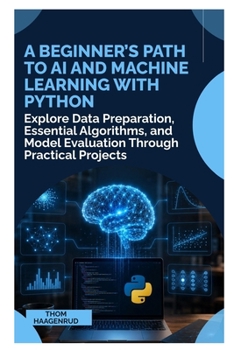
A Beginner's Path to AI and Machine Learning with Python: Explore Data Preparation, Essential Algorithms, and Model Evaluation Through Practical Proje

Machine learning becomes much easier when you understand the complete process-not just how to run an algorithm.
A Beginner's Path to AI and Machine Learning with Python gives you a clear, practical route from an unfamiliar dataset to reliable predictions and well-supported conclusions. Instead of overwhelming you with advanced mathematics or disconnected code snippets, this book teaches the reasoning behind each stage while you build useful skills step by step.
You will learn how to inspect information before changing it, prepare features correctly, choose methods that fit the problem, measure performance honestly, diagnose weak results, and create workflows that another practitioner can understand and reproduce.
Inside, you will learn how to:
Set up a clean Python workspace with virtual environments and Jupyter
Work confidently with NumPy, pandas, Matplotlib, and scikit-learn
Load, inspect, filter, summarize, and visualize structured datasets
Handle missing values, duplicates, inconsistent entries, incorrect types, and outliers
Encode categorical variables and scale numerical features correctly
Prevent information leakage during preprocessing and experimentation
Build complete regression and classification workflows
Apply linear regression, logistic regression, and k-nearest neighbors
Work with decision trees, random forests, and gradient boosting
Understand feature importance and compare competing approaches
Interpret confusion matrices, precision, recall, F1 score, ROC-AUC, and regression error measures
Handle class imbalance and choose meaningful decision thresholds
Use cross-validation to obtain more reliable performance estimates
Tune hyperparameters without contaminating the final test set
Build reproducible preprocessing and prediction pipelines
Discover patterns using k-means clustering
Use principal component analysis for dimensionality reduction and visualization
Diagnose common mistakes instead of blindly increasing complexity
The final section brings everything together through complete regression, classification, and customer-segmentation projects. You will move from problem definition and raw information through preparation, comparison, measurement, interpretation, and final review.
This book is designed for complete beginners, students, career switchers, analysts, developers, and working professionals who want a dependable foundation in predictive analytics. Previous programming experience is helpful but not required, and advanced calculus or linear algebra is not necessary to begin.
If tutorials have shown you how to run code but left you unsure why the steps matter, this book provides the missing structure.
Learn to understand the problem, prepare the evidence, build carefully, measure honestly, and develop the judgment needed to tackle your own projects with increasing independence.
Customer Reviews
ThriftBooks ® and the ThriftBooks ® logo are registered trademarks of Thrift Books Global, LLC
