


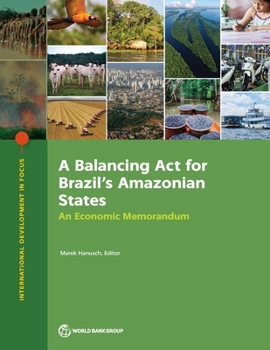
A Balancing Act for Brazil's Amazonian States: An Economic Memorandum

Brazil's nine Amazonian states, here collectively referred to as Amaz nia, include some of the world's richest ecosystems, including the Amazon rainforest and parts of the Cerrado savanna and Pantanal wetlands. The region is also among Brazil's poorest socioeconomically. As a result, sustainable, inclusive development of Amaz nia calls for raising living standards while protecting natural forests. A Balancing Act
for Brazil's Amazonian States: An Economic Memorandum explores how a recalibrated development approach can achieve these goals.
In the shorter term, there is an urgent need to halt deforestation--a massive destruction of natural wealth that poses risks to the climate and economy. Amaz nia is Brazil's deforestation hot spot, and the Amazon rainforest is approaching tipping points into broad and permanent forest loss. Reversing the recent increase in deforestation requires stronger land and forest governance, including land regularization and more effective law enforcement.
In the longer term, both Brazil and Amaz nia need a new growth model. This model would be anchored in productivity rather than resource extraction and it would diversify the export basket beyond commodities. A more balanced structural transformation requires the lagging urban sectors, such as manufacturing and services, to step up to promote economic growth, reduce pressure on the agricultural frontier, and generate jobs for Brazil and Amaz nia's largely urban populations. The public-good value of Amaz nia's forests could generate conservation finance linked to verifiable reductions in deforestation. Such financing would support a new development approach, combining forest protection, productivity, balanced structural transformation, sustainable production techniques (including the bioeconomy), and other measures to address the needs of Amaz nia's urban and rural populations. This approach must also heed the needs and interests of Amaz nia's traditional communities.
Given both the value and the fragility of Amaz nia's ecosystems, coupled with considerable socioeconomic local needs, the stakes are high-for Amaz nia, Brazil, and the world.
Customer Reviews
ThriftBooks® and the ThriftBooks® logo are registered trademarks of Thrift Books Global, LLC
